The Letterbook of the Columbian Commerical Agency in Jamaica, 1832-1839
and the Letterbook of the Consul of Columbia in Jamaica, 1844-1861
|
|
ABSTRACT
The Letterbook of the Columbian Commercial Agency in Jamaica contains two sections, its namesake dated from 1832 to 1839 and the Letterbook of the Consul of Columbia in Jamaica dated from 1844 to 1861. Both Letterbooks are in Spanish and are useful for persons studying Jamaica’s foreign relations in the nineteenth century. The Letterbooks contain the impression of the Consul members of life in Jamaica. Subjects dealt with include the situation of the formerly enslaved Africans in Jamaica, housing, sugar estates and provisions. An examination of the Letterbooks would give an honest eye-witness and outsider’s view of Jamaica in the nineteenth century.
PART A – ESSENTIAL INFORMATION
IDENTITY AND LOCATION
Name of Documentary Heritage: The Letterbook of the Columbian Commercial Agency in Jamaica, 1832-1839 and the Letterbook of the Consul of Columbia in Jamaica, 1844-1861
Country: Jamaica and Columbia
State, Province or Region: The Caribbean
Address: The National Library of Jamaica, 12 East Street, Kingston
LEGAL INFORMATION
Owner (Name and contact details):
The National Library of Jamaica
12 East Street
Kingston
Tel: (876) 967-1526, 967-2516
Fax: (876) 922-5567
Email: nlj@infochan.com
Custodian: As above
Legal Status: Public
Details of Legal and Administrative provisions for the preservation of the documentary heritage:
Responsibility for the care, preservation and use of the Letterbook of the Columbian Commercial Agency in Jamaica and the Letterbook of the Consul of Columbia in Jamaica lie with the Special Collections and Conservation Dept. of the National Library where it forms part of the Manuscript Collection.
Accessibility: The Letterbook of the Columbian Commercial Agency in Jamaica, 1832-1839 and the Letterbook of the Consul of Columbia in Jamaica, 1844-1861 are available to members of the public for consultation, in particular researchers and academics.
Copyright Status: Due to the age of the material, being over 150 years old, the letterbooks are in the public domain.
Responsible Administration: The Letterbook of the Columbian Commercial Agency in Jamaica and the Letterbook of the Consul of Columbia in Jamaica are located at the Special Collections and Conservation Dept. of the National Library of Jamaica and responsible administration for it lies with the Executive Director of the National Library.
IDENTIFICATION
Description and inventory: There is only one volume of the Letterbook of the Columbian Commercial Agency in Jamaica. The letters are in Spanish and are written to members of the Columbian government outside of Jamaica. They chiefly deal with the commercial link between Jamaica and Columbia that existed during this period. Additionally, letters deal with epidemics and the social situation in Jamaica. The ink used on the first few pages is so pale as to make the writing/content almost invisible.
The Columbia (Nueva Granada) Consulate was located in Kingston, Jamaica. The Letterbook of the Consul of Columbia contains copies of all out-letters of the Consul and span September 17, 1844 to May 2, 1861. The letters are written in Spanish. The Letterbook of the Consul of Columbia in Jamaica deals with several subjects. This includes the plight of the free Blacks in Jamaica, housing, agriculture, and provisions. The first letter in particular gives an overview of the situation in Jamaica through the eyes on the Consul. The Letters are written to Secretaries of State, Prefects and other members of the Columbian government.
Bibliographic details: Letterbook of the Columbian Commercial Agency in Jamaica and the Letterbook of the Consul of Columbia in Jamaica are filed under MS 294 in the card catalogue in the Special Collections and Conservation Dept. of the National Library.
HISTORY
MANAGEMENT PLAN
Bibliographic: Bibliographic details of the Letterbook of the Columbian Commercial Agency in Jamaica and the Letterbook of the Consul of Columbia in Jamaica are located in the card catalogue on site in the Special Collections and Conservations Dept. at the National Library. Ongoing efforts are being made to place such details in a database which will eventually be placed online to provide access to patrons unable to come into the library.
Preservation Plan: The Letterbooks are in a fragile state. Both books need to be rebound as the covers are missing. Furthermore, in the case of the Letterbook of the Consul of Columbia in Jamaica, water stains have ruined the first few pages, making the content unreadable. The Letterbook of the Columbian Commercial Agency in Jamaica also has similar problems resulting from water marks. The National Library has however made plans to have both books rebound. Likewise, patrons are urged to utilise gloves provided by the Special Collections and Conservation Dept. when consulting the
Letterbooks.
ASSESSMENT AGAINST THE SELECTION CRITERIA
Influence
The Letterbook of the Columbian Commercial Agency in Jamaica and the Letterbook of the Consul of Columbia in Jamaica are useful for persons interested in studying Jamaica’s social and economic affairs during this period. It would be interesting to study the relations between the two countries during this period. Additionally, the fairly candid comments of the consul can aid in representing life in Jamaica. Today, Jamaica has ties with Columbia and from the Letterbooks it would seem that this relation was cemented early on.
Time
The Letterbook of the Columbian Commercial Agency in Jamaica came into being in 1832. This was two years before the abolition of slavery and one year following the Sam Sharpe Rebellion. As such, the study of this Letterbook would encapsulate the impact of the Rebellion and the turning point in Jamaica’s history. The Letterbook spans the abolition of slavery in 1834, the apprenticeship system and its ending in 1839. These dates and events are so integral to Jamaica’s history and development that a Letterbook that spans these major turning points cannot be ignored. The Letterbook of the Consul of Columbia in Jamaica came about in 1844, two years before the Sugar Duties Equalisation Act and goes up to 1861, four years before the Morant Bay Rebellion. The Sugar Duties Equalisation Act had a devastating effect on the Jamaican sugar industry and resulted in common hardship all over Jamaica. The Morant Bay Rebellion resulted in the replacement of the Old Representative System of Government by Crown Colony Government and as such marks a defining moment in Jamaica’s constitutional history. As such, this Letterbook would be useful for persons interested in the state of affairs in Jamaica during these time frames.
Place
The Letterbooks were written in Jamaica by persons not from Jamaica. As such, they allow for an interesting outsider’s look at conditions in Jamaica. The Consuls were located in Kingston, Jamaica and perhaps the letters would be framed by conditions in that city.
People
The letters were written by representatives of Columbia in Jamaica. Such persons were mainly ambassadors and ministers. The persons that they wrote to were Secretaries of State, Prefects and other Columbian government officials. The letters are useful for the study of eye-witness views of conditions in Jamaica, conditions that were brought to the attention of the Columbian government. The honest views that these persons may have had about members of the Jamaican Assembly and Council might prove useful for persons studying the Old Representative System of Government in Jamaica.
Subject/Theme
The Letterbook of the Columbian Commercial Agency in Jamaica and the Letterbook of the Consul of Columbia in Jamaica will prove useful for persons wishing to study the economic, political and social conditions in Jamaica. Likewise persons studying the diplomatic history of Jamaica will find the Letterbooks invaluable.
Form/Style
The letters are written in Spanish and as such Latin American style of address will be utilised. Persons wishing to study comparative language styles of address will no doubt enjoy examining the Letterbooks.
Criterion 7, Social Value: The Letterbook of the Columbian Commercial Agency in Jamaica and the Letterbook of the Consul of Columbia in Jamaica are very important. They are of social value because they span major turning points in Jamaica’s history, including the abolition of slavery, the apprenticeship and its ending, the Sugar Duties Equalisation Act and the conditions that started the road to the Morant Bay Rebellion.
Integrity
As a result of water marks and the resultant effect to the ink and the contents of the letters, Letterbook of the Columbian Commercial Agency in Jamaica and the Letterbook of the Consul of Columbia in Jamaica are equally compromised. The pages are at times brittle and fragile and the letters sometimes hard to read because the ink has become pale due to age.
Rarity
The Letterbook of the Columbian Commercial Agency in Jamaica and the Letterbook of the Consul of Columbia in Jamaica may not be extremely rare if copies of the letters written exist outside of Jamaica. However, the Letterbooks are unique because they are the only ones located in Jamaica and the Caribbean.
CONSULTATION
The National Library
12 East Street
Kingston
Tel: (876) 967-1526, 967-2516
Fax: (876) 922-5567
Email: nlj@infochan.com
NOMINATOR
Dr. James C. Robertson
Department of History and Archaeology
University of the West Indies, Mona
Jamaica.
PART B
ASSESSMENT OF RISK AND PRESERVATION ASSESSMENT
The Letterbook of the Columbian Commercial Agency in Jamaica and the Letterbook of the Consul of Columbia in Jamaica are fragile due to age. Liquid has affected the state of some of the letters and as a result watermarks have made the ink pale and the contents of the letters unreadable in certain cases. This also has a negative impact of the leaves of the books. However, considering the age of the Letterbooks and the effect of the liquid on the leaves, the Letterbooks are surprisingly in fair condition. However, the National Library has made arrangements for the Letterbook of the Columbian Commercial Agency in Jamaica and the Letterbook of the Consul of Columbia in Jamaica to be rebound in due time.
Top
|
THE LUCKY VALLEY ESTATE PLANS
|
ABSTRACT
The Lucky Valley Estate Plans are useful for examining changes to the Lucky Valley Estate over time. Various maps exist of this estate, until it came into the possession of Isaac Barnes and the 1883 plan of Lucky Valley Estate was redrawn to represent this new ownership. As Barry Higman in Jamaica Surveyed writes, “Probably the most graphic example of an appreciation of the general principles of plantation layout is provided by a plan of Lucky Valley Estate, in upper Clarendon, belonging to the planter-historian Edward Long”.
PART A – ESSENTIAL INFORMATION
IDENTITY AND LOCATION
Name of Documentary Heritage: The Lucky Valley Estate Plans
Country: Jamaica
State, Province or Region: Caribbean
Address: The National Library of Jamaica 12 East Street, Kingston
LEGAL INFORMATION
Owner (Name and contact details):
The National Library of Jamaica
12 East Street
Kingston
Tel: (876) 967-1526, 967-2516
Fax: (876) 922-5567
Email: nlj@infochan.com
Custodian: As above
Legal Status: Public
Details of Legal and Administrative provisions for the preservation of the documentary heritage:
Responsibility for the care, preservation and use of the Lucky Valley Estate Plans lies with the Special Collections and Conservation Dept. of the National Library where it forms part of the Manuscript Collection.
Accessibility: The Lucky Valley Estate Plans is available to members of the public for consultation, in particular, researchers and academics.
Copyright Status: The collection is not covered by copyright.
Responsible Administration: The Lucky Valley Estate Plans are located at the Special Collections and Conservation Dept. of the National Library and responsible administration for the collection lies with the Executive Director of the National Library.
IDENTIFICATION
Description and inventory:
The Lucky Valley Estate Plan is drawn to perfection, reflecting the Juan de Bolas River to the north, to the left Oaks Estate and the right Unity Plantation. Lucky Valley was a sugar estate and as such all maps reflected this by noting in general the number of acreage in canes, pasture, woodlands, accommodation and grounds for the enslaved, the factory and works, the great house and the boundaries discussed above. One of the earliest maps of Lucky Valley was drawn by James Blair in 1769 at the request of Edward Long. Higman notes how striking this map is, “What is most striking about this plan is that it incorporates a series of concentric circles and arcs, drawn at quarter-mile intervals, superimposed over the layout of the estate and clearly centred on the mid-point of the works building.” Other maps were drawn by surveyors Kenneth Morison in 1773, Benjamin Hayes in 1816 and the map of 1883 witnessed by Isaac Barnes. Overall the maps are all well done and rather detailed.
Bibliographic details:
There are several copies of Lucky Valley estate maps as discussed above. They are all located in the online database available at the National Library. In addition, they are catalogued by parish and so begin with Clarendon followed by a number.
Visual Documentation:
Photographs exist of the Lucky Valley Estate Plans and they have been used as illustrations in several books in particular Barry Higman’s Jamaica Surveyed: Plantation Maps and Plans of the Eighteenth and Nineteenth Centuries.
HISTORY
The Lucky Valley Estate Plans form part of the Cadastral Map Collection which consists of maps and plans that were prepared by private surveyors. All maps, except the last. was ordered by members of the Long family including Edward Long and Edward Beeston Long. Oftentimes, the maps were done up in response to new additions to the land, death of the owner (in the case of E. Beeston Long) or on the proprietor leaving to go overseas (Edward Long). Between 1876 and 1891 the maps and plans were collected by Thomas Harrison, the Surveyor General who made use of them in producing the cadastral maps of the parishes of Jamaica. In the 1940s, the collection was handed over to the Institute of Jamaica and placed in the West India Reference Library. The collection of this library became the basis of the National Library when it was established in 1979.
MANAGEMENT PLAN
Bibliographic:
The bibliographic details of the maps are available online via the database on site at the National Library.
Preservation Plan: The Lucky Valley Estate Maps are overall fairly well preserved. Patrons are urged to use gloves and the maps are stored in acid free folders. In addition, preservation work, for example was done on the 1883 map and as such, the original map was glued to rice paper. There are however tears along the creases and the bottom right has been eaten away somewhat due to corrosion. This does not, however, ruin or affect the map itself.
ASSESSMENT AGAINST THE SELECTION CRITERIA
Influence
The Lucky Valley Estate Plans are useful for persons wishing to study land usage and tenure, especially since it is argued that the general principles of plantation layout is adhered to by the Lucky Valley Estate. Likewise, it gives some information for persons wishing to study early surveying techniques and landscape history. Persons wishing to study the Longs will do well to consult these maps since they give evidence of decline over time. The Longs were prominent members of the West India Lobby and also powerful London merchants who were influential both in the Caribbean and in England. Edward Long, for example, wrote the three volumes of History of Jamaica which are used by almost every historian studying the 18th century Jamaica. Long gives tips for planters on the layout of their plantation and so forth. It would be interesting to note whether his views etc, were reflected in his estate plan.
Time
The Lucky Valley Estate Maps stretch over a number of years. As Higman notes, the maps not only give dates but also the possessions of the estate. What is clear therefore, is that to study these maps is also to study decline over the course of two generations. However, while there is material decline in wealth, land was added on to the estates. As such, time, in terms of a stretch of time is useful in this case.
Place
The Lucky Valley Estate is located in Clarendon, Jamaica. Persons wishing to study land usage, etc in Clarendon can use the Lucky Valley Estate Plans as a microcosm of the study of estates in Clarendon in general, especially since the Lucky Valley Estate was a reflection of the ideal layout of an estate.
People
The first family who owned the Lucky Valley Estate were the Longs. These were powerful and wealthy person. Samuel Long for example was a member of the Jamaican Assembly as was Edward Long, who wrote the History of Jamaica. It is worth mentioning that the merchant firm the family owned and ran in London was a factor for many West Indian planters. The Longs were also powerful lobbyist, belonging to the West India Interest. As such, one cannot study these persons without also looking at their plantations.
Subject/Theme
The Lucky Valley Estate Plans are useful in the study of Jamaican economic history, land ownership, land tenure and usage, history of surveying, and map making.
Form/Style
Persons wishing to study the surveying techniques, the material used and the format of early maps and plans of former surveyors will find the Lucky Valley Estate Plans invaluable.
Social Value
The Lucky Valley Estate Plans are a valuable primary source of Jamaica’s social and economic history. It reflects the ideal layout of a plantation and indicates land tenure and usage.
Integrity and Rarity
The Lucky Valley Estate Plans are in fairly good condition. They are especially unique, in that the National Library possesses the only originals.
CONSULTATION
Prof. Barry Higman
National University of Australia
Canberra
Australia
NOMINATOR
National Memory of the World Committee Jamaica (1999)
PART B
ASSESSMENT OF RISK AND PRESERVATION ASSESSMENT
The Lucky Valley Estate Plans are in the main, well preserved. Patrons are advised to use gloves when consulting the maps and in addition, the maps are preserved in acid free folders which reduce the risk of corrosion. However, funds are needed to digitise these maps.
Top
|
Manumission
of Slaves
|
|
ABSTRACT
The records of manumission of slaves are deeds freeing enslaved people. It includes 70 volumes of deeds spanning the 18th and 19th centuries. Volume 70, which is dated after emancipation in 1834, contains the deeds releasing persons from apprenticeship.
IDENTITY AND LOCATION
Name of documentary heritage: Manumission of Slaves
Country: Jamaica
State, Province or Region: West Indies
Address (location of doc): Jamaica Archives, Corner of King and Manchester Streets, Spanish Town.
Legal Information
Owner: The Jamaica Archives
Custodian: as above
Legal Status: These records are owned by the Jamaica Archives, and are accessible to the public. There are no restrictions on its use within the purview of proper treatment of the documents
Details of legal and administrative provision for the preservation of the Documentary heritage:
Accessibility: Like all other Archival holdings, these volumes cannot be removed from the Clinton Black Reading Room, the central reading room in the Jamaica Archives.
Copyright Status: The age and state of many of the paper documents in this collection make them difficult to reproduce by photocopying, but digitizing under the supervision of archive staff of a selected amount, as well as note taking is permitted. Those that are microfilmed can be reproduced to paper format.
Responsible administration: Responsibility for the collection is with the Government Archivist.
Identification
Description:
These records are in 70 bound volumes. The first 4 volumes were listed as missing, in the list of record books in the Island Secretary’s Office compiled in 1869.
The documents begin in the year 1747 and there end in 1838, the end of the apprenticeship period. Some of these records are also in microfilm form and has an individual index at the front of each volume. They are hand written and include the sum of money paid to free the enslaved person. It also includes the name of the enslaved person, the previous owner, and details about the person including skin colour, kin as well as the parish they lived and worked in.
Bibliographic Details:
This collection includes 2 index volumes in which entries are recorded under the name of the manumitter but not of the person manumitted. The first volume covers libers 12-53 (1778-1819) and the second includes libers 54-68 (1819-1833). In addition most of the volumes including numbers 5-7, 9, 12, 69, 70 have their own indices.
HISTORY
The list of record books in the Island Secretary’s Office was compiled in 1869. These would have been handed over to the National Archives after 1953, when a committee was appointed specifically for the archives as a section of the Island Record Office, established in 1879, following the passing of the Island Records Law (law 6 of 1879).
ASSESSMENT AGAINST THE SELECTION CRITERIA
Influence
Documents such as these are invaluable sources of the study of slavery in the Caribbean and more specifically, Jamaican context. They have helped to shed light on the process of freedom in the context of a slave society and have been used my myriad historians as sources for a variety of studies. Though it was only relatively fee enslaved people that got their freedom before emancipation in 1834, these documents offer an insight into the ‘anomalies’ of freed blacks and coloureds in this structure of the slave society.
Time
Volumes 12-53 cover the period 1778-1819 while volumes 54-68 1819-1833. these dates cover the period of slavery in Jamaica, which was officially ended in 1834. The period of apprenticeship from 1834 to 1838 is reflected in a final volume which includes deeds for those persons who were released, usually by payment, from apprenticeship.
Place
The records are also significant in that they usually include the exact location by parish and occasionally estate that the enslaved person is being released from. Therefore one is able to get a picture of the trends of manumission according to parish and estate. One is also able to get a picture of the significance of manumission in Jamaica as a premier slave society which in was strategically, one of the most important sugar producing British colonies of the 18th century.
People
Enslaved people, as chattel were robbed of their human identity, and reduced to cargo, and property of other persons. Probably the most poignant contribution of this collection to historiography and the study of history itself, is that it sheds light on what people were worth in monetary terms. One is also able to trace the owners of these enslaved people identify trends as to which properties engaged in manumission of their enslaved people.
Social Value
By listing names, kin, and the amount of money needed to free a person from life long servitude, this collection allows historians and other interested persons a better insight into the value of enslaved people to the plantation economies of the Caribbean and Jamaica. It is also useful for genealogical studies, as families can be traced through these documents since hey include the kin of the newly freed person, as well as the former owners and parish of birth.
Integrity
These documents are original hand written documents that have been preserved in their original state as well as on microfilm.
Rarity
These are one of the few documents which state how much money enslaved persons were worth. This collection is the only one of this nature in the island.
MANAGEMENT PLAN
Preservation Plan: The archive takes special precautions to safeguard the quality of its collections, by instructing patrons in the proper techniques when using the documents. Patrons are not allowed to use pens in the reading room, and are sometimes offered magnifying glasses if the material is hard to decipher. Proper handling of these records is stressed. The archive has embarked on a 5 year plan to microfilm all its collections, particularly older ones and those that are deteriorating with time. However the completion of this is contingent on funding. Nonetheless the very early documents in this collection have been microfilmed and patrons are usually given the microfilmed version to use rather than the bound volumes to ensure survival of the original documents.
CONSULTATION
John Aarons
53-56 Church street
Kingston
Tel: (876) 922 3705-6
NOMINATOR
Jamaica Archives
Top
|
A MAP OF THE WEST INDIES AND MIDDLE CONTINENT OF AMERICA, 1790
|
|
ABSTRACT
A Map of the West Indies and Middle Continent of America was drawn by John Blair as a supplement to his tables of chronology. This map is very descriptive and contains drawings of Cuba, Jamaica, St. Domingo, the Leeward Islands, a bit of South America, Panama, Costa Rica, Nicaragua, Honduras, Yucatan, and Florida, Georgia and Louisiana in North America. The smaller islands of the Bahamas, Providence and the tiny French islands of Marie Galante, Martinique and Guadeloupe are also represented. This map is especially useful for researchers of the topography of the West Indies and visual representation in the 18th century.
PART A – ESSENTIAL INFORMATION
IDENTITY AND LOCATION
Name of Documentary Heritage: A Map of the West Indies and Middle Continent of America, from the latest observations by John Blair LLD, and FRS as a supplement to his tables of chronology, 1790.
Country: Jamaica
State, Province or Region: West Indies
Address: The National Library of Jamaica, 12 East Street, Kingston
LEGAL INFORMATION
Owner (Name and contact details): The National Library
12 East Street
Kingston
Tel: (876) 967-1526, 967-2516
Fax: (876) 922-5567
Email: nlj@infochan.com
Custodian: As above
Legal Status: Public
Details of Legal and Administrative provisions for the preservation of the documentary heritage: Responsibility for the care, preservation and use of John Blair’s Map of the West Indies and Middle Continent of America lies with the Special Collections and Conservation Dept. of the National Library of Jamaica where it forms part of the Manuscript Collection.
Accessibility: The John Blair’s Map of the West Indies and Middle Continent of America is available to members of the public for consultation, in particular, researchers and academics.
Copyright Status: Due to the age of the document, being over 200 years old, the map is not covered by copyright.
Responsible Administration: John Blair’s Map of the West Indies and Middle Continent of America is located at the Special Collections and Conservation Dept. of the National Library and responsible administration for the collection lies with the Executive Director of the National Library.
IDENTIFICATION
Description and inventory:
John Blair’s Map of the West Indies and Middle Continent of America is fairly descriptive and includes most areas in the region including Cuba, Jamaica, St. Domingo, The Leeward Islands, sections of South America including Venezuela, Central American states, including Panama, Costa Rica, Nicaragua, Honduras, Yucatan and sections of North America including bits of Florida, Georgia and Louisiana. Other countries include the Bahamas, Providence Island, Guadeloupe, Martinique and Marie Galante. Blair also makes note of the Pacific and Atlantic Oceans and the Gulf of Mexico. Initial observation allows one to observe that all the Caribbean Islands are represented, and while this is the case, Blair’s West Indian map lacks internal detail and as such, places are not at all named at times. In addition, the topography of each territory is ignored. But this can be attributed to the size of the map and the fact that what Blair lacks internally he more than makes up for externally by making note of even the tiniest lava island.
Bibliographic details:
Bibliographic details John Blair’s Map of the West Indies and Middle Continent of America is located on site in the card catalogue in the Special Collections and Conservations Dept. Likewise, its details are being placed in a database that can be accessed at the National Library. In time, this database will be put online, where it will become easily accessible to persons unable to visit the National Library.
HISTORY
John Blair’s Map of the West Indies and Middle Continent of America was published in 1790 as a supplement to his tables of chronology.
MANAGEMENT PLAN
Bibliographic:
Bibliographic details of John Blair’s Map of the West Indies and Middle Continent of America are available in the card catalogue, which is on site at the National Library’s Special Collection and Conservations Dept. In addition, efforts are being made to place these details in a database, which will eventually become available to persons online who are unable to visit the National Library.
Preservation Plan:
John Blair’s Map of the West Indies and Middle Continent of America is overall very well preserved. Patrons are advised to use gloves when consulting this manuscript. In addition, the map is stored in an acid free folder.
ASSESSMENT AGAINST THE SELECTION CRITERIA
Influence
John Blair’s Map of the West Indies and Middle Continent of America is very useful for persons studying the regional development of the Caribbean and the Americas. Blair’s map is reader friendly and easy to use. Though not possessing thorough representation of the internal parts of the territories, Blair has indeed made up for this in his very comprehensive map of the West Indies. It is useful for persons studying the West Indies as a reference map because Blair’s map has the old names of some territories. Very few maps of this early period depict the West Indies in such detail.
Time and Place
John Blair’s Map of the West Indies and Middle Continent of America was published in 1790 and as such it is valuable for 18th century researchers. In addition, the scope of the map is not just limited to the Caribbean but includes also portions of North, Central and South America or even English speaking territories.
People
The persons who occupied the places covered by the map were from different races, including Europeans, Africans and Amerindians.
Subject/Theme
John Blair’s Map of the West Indies and Middle Continent of America is useful for the study of the spatial distribution of the islands. In addition, persons interested in the changes to the names of places over time will find this map especially useful.
Form/Style
The map drawn by Blair is especially detailed. In addition it is consistent with 18th century style. Persons interested in the spelling of words and the changes to the names of countries over time find it useful.
Social Value
John Blair’s Map of the West Indies and Middle Continent of America possesses tremendous social value for the study of the West Indies. Unlike most maps of its time, Blair’s map is especially comprehensive as it relates to territories and more than likely, historians of the West Indies will always seek to use this map in their works.
Integrity
John Blair’s Map of the West Indies and Middle Continent of America is very well preserved and all the text is in good order.
Rarity
John Blair’s Map of the West Indies and Middle Continent of America is very unique owing to the undue attention paid to geographic spaces.
CONSULTATION
NOMINATOR
PART B
ASSESSMENT OF RISK AND PRESERVATION ASSESSMENT
John Blair’s Map of the West Indies and Middle Continent of America is very well preserved. It is kept in acid free folders and patrons are urged to use gloves when consulting this source. The map is also reader friendly.
Top
|
THE NINETEENTH CENTURY NEWSPAPER COLLECTION
|
ABSTRACT
Unlike the National Library’s Eighteenth Century Newspaper Collection, the Nineteenth Century Newspaper Collection, although overwhelmingly Jamaican, is more varied and contains newspapers from all over the Caribbean. Newspapers are featured from Antigua, Barbados, British Guiana, the Cayman Islands, Dominica, Grenada, Haiti, St. Kitts, St. Lucia and Trinidad and Tobago. Additionally, the Nineteenth Century Newspaper Collection reached a much wider contemporary audience than did the Eighteenth Century Collection whose readership was mainly the white plantocracy. There were newspapers in the nineteenth century that were run by and catered to the free blacks and coloured inhabitants of Jamaica. This century saw the continuation of papers from the eighteenth century and the discontinuation of others. Likewise, many newspapers were launched including the Jamaica Gleaner. Overall, the newspapers of the nineteenth century are more varied in their audience, ownership and subject matters than those of the eighteenth century and as such the Nineteenth Century Newspaper Collection would be useful for persons studying the economy, politics and society of nineteenth century Jamaica.
PART A – ESSENTIAL INFORMATION
IDENTITY AND LOCATION
Name of Documentary Heritage: The Nineteenth Century Newspaper Collection
Country: The Caribbean
State, Province or Region: The Caribbean
Address: The National Library, 12 East Street, Kingston
LEGAL INFORMATION
Owner (Name and contact details): The National Library
12 East Street
Kingston
Tel: (876) 967-1526, 967-2516
Fax: (876) 922-5567
Email: nlj@infochan.com
Custodian: As above
Legal Status: Public
Details of Legal and Administrative provisions for the preservation of the documentary heritage: Responsibility for the care, preservation and use of the Nineteenth Century Newspaper Collection lies with the Special Collections and Conservation Dept. of the National Library where it forms part of the Manuscript Collection.
Accessibility: The Nineteenth Century Newspaper Collection is available to members of the public for consultation, in particular, researchers and academics.
Copyright Status: Due to the age of the newspapers, the newspapers are not covered by copyright. However, since most of the Nineteenth Century Newspapers were recently microfilmed, copyright for the use of such microfilm images lies with those who microfilmed it.
Responsible Administration: The Nineteenth Century Newspaper Collection is located at the Special Collections and Conservation Dept. of the National Library of Jamaica and responsible administration for the collection lies with the Executive Director of the National Library of Jamaica.
IDENTIFICATION
Description and inventory:
Most of the Nineteenth Century Newspaper Collection has been placed on microfilm. Even bound copies were recently microfilmed so that the entire collection has been done. The Nineteenth Century Newspaper Collection covers newspapers from all over the English Caribbean and include:
Antigua
The Weekly Register
Barbados
The Barbadian
The Barbados Mercury and Bridgetown Gazette
The Times
British Guiana/Guyana
Essequebo and Demerary Royal Gazette®Royal Gazette of the United Colony of Essequebo and Demerary (1817)®Royal Gazette of British Guiana (1832)
The Cayman Islands
The Royal Gazette and Turks and Caicos Islands Commercial Literary Political Journal
Dominica
The Dominican
The Dominica Colonist
Grenada
The St. George Chronicle and Grenada Gazette
The New Era
The Equilibrium
Haiti
Bulletin Official Du Port - Republican
Jamaica
The Royal Gazette
The St. Jago De La Vega Gazette
The Diary and Kingston Daily Advertiser
The Jamaica Courant
Cornwall Chronicle Supplement
The Kingston Chronicle
The Buckatoro Journal
The Trifler
The New Times
The Struggler
The Watchman and Jamaica Free Press
The Patriot
The Gleaner Commercial Advertiser
Jamaica Despatch and Shanon’s Daily Messenger
The Falmouth Post
The Morning Journal
The Jamaica Standard
De Cordova’s Mercantile Intelligencer
The Colonial Standard and Jamaica Despatch
Lawton’s Commercial Gazette
The Jamaica Tribune and Daily Advertiser
Anglo-Jamaican Advertiser
The Sentinel Country Union and Anglo-Jamaican Advertiser
The Jamaica Guardian
Gall’s Newsletter
The Jamaica Instruction
The Budget
The Trelawny and Public Advertiser
The Jamaica Witness
Westmoreland Telegraph and Planters’ Gazette
The Jamaica Colonialist
The Jamaica Creole and Daily Recorder
The Nineteenth Century and St. James Gazette
The Evening Express
The West India Field Colonial Wesleyan Chronicle
The Jamaica Post
The Jamaica Advocate
The Daily Telegraph and Anglo-American Herald
St. Kitts
The St. Christopher Advertiser and Weekly Intelligencer
St. Lucia
The Voice of St. Lucia
Trinidad and Tobago
Trinidad Gazette
Trinidad and Tobago Chronicle
Tobago Gazette
Turk and Caicos Islands
The Turks Island Gazette and Commercial Reporter
The Royal Standard and Gazette of the Turks and Caicos Islands
The Turks Islands
The owners and readership of nineteenth century newspapers was in general wider than that of the eighteenth century. The nineteenth century witnessed the rise of newspapers owned by the free coloured and black factions of the Jamaican society, for example. The Watchman and Jamaica Free Press for instance was owned by a member of the coloured middle class. Though the subject matters of the nineteenth century newspapers were at times similar to that of the eighteenth century, due to a readership more extensive than the white plantocracy, the issues dealt with were more varied. They included topics such as the inequality and injustice meted out the mixed population, emancipation, religious affairs and agriculture.
Bibliographic details:
The Nineteenth Century Newspaper Collection is located at the National Library’s Special Collection and Conservation Dept. where there are several detailed catalogues. These catalogues give the dates of the newspapers, the extent of the collection in terms of certain years and whether or not a specific newspaper is on microfilm or bound or photocopied.
Visual Documentation: Most of the Nineteenth Century newspapers are on microfilm.
HISTORY
MANAGEMENT PLAN
Bibliographic:
While there are detailed catalogues of the extent of the National Library's nineteenth century newspaper holdings, there is no card catalogue of it. However, attempts are being made to place the bibliographic details of the newspapers on a database that will be placed online.
Preservation Plan:
The Nineteenth Century Newspaper Collection has been preserved by the National Library in the form of microfilm.
ASSESSMENT AGAINST THE SELECTION CRITERIA
Influence
Nineteenth century newspapers have been used repeatedly by academics researching the Caribbean in the nineteenth century. Most research has been in some form or another influenced by data found in these newspapers and as a result it is often the first point of reference for students and historians of nineteenth century Caribbean economy, politics and society.
Time
The Nineteenth Century Newspaper Collection covers a momentous period of the Caribbean’s history. This includes the general decline of the sugar planters, decisive slave revolts to topple the system of enslavement, the emancipation of the enslaved people, immigration and indentureship, the Morant Bay Rebellion and the change from the Old Representative System of government to the Crown Colony system.
Place
The National Library possesses an extensive collection of nineteenth century newspapers that almost spans the entire English speaking Caribbean. These Caribbean Islands were at this point in history, colonies of England and as such their policies were influenced by the vicissitudes of England.
People
Unlike the Eighteenth Century Collection of Newspapers, which focuses on the white Jamaican plantocracy, the Nineteenth Century Collection is more varied resulting from a wider readership. The nineteenth century witnessed the rise of specialised newspapers dealing with the needs of the disenfranchised free blacks and coloureds. As such it is safe to argue that the newspapers of the nineteenth century give a more holistic view of Caribbean society.
Subject/Theme
Persons interested in studying the evolution and development of Caribbean society, economy and politics would do well to use the nineteenth century newspapers as a starting point of reference. Other topics that can be examined using these newspapers are immigration and indentureship and agriculture.
Form/Style
The Nineteenth Century Newspaper Collection comes from different English speaking Caribbean islands. Accordingly each newspaper would have its own unique layout and as such persons wishing to undertake a comparative study of newspaper layouts would want to take a look at these newspapers.
Social Value
The Nineteenth Century Newspaper Collection is of tremendous social value, being the media through which public opinions could be expressed; public opinions that this time would include large segments of the disenfranchised population. Additionally, the nineteenth century marked great social, economic and political changes in the Caribbean and the newspapers would chronicle these changes and the opinions of sections of its populace would be contained therein.
Integrity
Unfortunately, some of the newspapers are incomplete and gaps in years are evident. This does not reduce the value of the Nineteenth Century Newspaper Collection and as such they are still a useful point of reference. The microfilm copies of some of the newspapers are pale.
Rarity
Though copies of some of these newspapers are held elsewhere, the National Library possesses one of the largest collection of nineteenth century Caribbean newspapers.
CONSULTATION
The National Library
12 East Street
Kingston
Tel: (876) 967-1526, 967-2516
Fax: (876) 922-5567
Email: nlj@infochan.com
NOMINATOR
National Memory of the World Committee Jamaica (1999)
PART B
ASSESSMENT OF RISK AND PRESERVATION ASSESSMENT
Most of the nineteenth century newspapers are on microfilm. However the microfilms are at times rather pale, resulting in difficulty reading.
Top
|
The
Nuttal Collection
|
|

Bust of the Right Rev. Enos Nuttall
ABSTRACT
The Nuttall Collection consists of the correspondence, papers, and sermons of the Right Rev. Enos Nuttall, Bishop of Jamaica and Archbishop of the West Indies. The collection spans the period c. 1863-1916. This collection is vital for the study of the Anglican Church in Jamaica during the time period of the collection. In addition, the collection will also benefit persons wishing to study the development and history of education, social and charitable institutions of Jamaica during the late nineteenth and early twentieth centuries.
PART A – ESSENTIAL INFORMATION
IDENTITY AND LOCATION
Name of Documentary Heritage: The Nuttall Collection
Country: Jamaica
State, Province or Region: Caribbean
Address: The National Library, 12 East Street, Kingston
LEGAL INFORMATION
Owner (Name and contact details): The National Library
12 East Street
Kingston
Tel: (876) 967-1526, 967-2516
Fax: (876) 922-5567
Email: nlj@infochan.com
Custodian: As above
Legal Status: Public
Details of Legal and Administrative provisions for the preservation of the documentary heritage: Responsibility for the care, preservation and use of the Nuttall Collections lies with the Special Collections and Conservation Dept. of the National Library where it forms part of the Manuscript Collection.
Accessibility: The Nuttall Collection is available to members of the public for consultation, in particular, researchers and academics.
Copyright Status: The collection was handed over as a gift to the Institute of Jamaica and to the National Library of Jamaica on its establishment .
Responsible Administration: The Nuttall Collections is located at the Special Collections and Conservation Dept. of the National Library and responsible administration for the collection lies with the Executive Director of the National Library.
IDENTIFICATION
Description and inventory:
The Nuttall Collection is comprised of 38 boxes containing letter-books, memoranda, magazines and newspapers, synod papers and sermons. As such, the Collection contains original correspondence received by Nuttall and the diocese of Kingston, his diaries, 1866-1916; his letter-books, 1881-1909; his sermons, 1864-1915 as well as a wide assortment of printed and manuscript documents such as synod minutes, ordination papers, church financial papers and memoranda. Letters were written by the Jamaican clergy, Anglican laymen, overseas bishops, the governors of Jamaica including Sir Anthony Musgrave and Sir Henry Norman. Aside from ecclesiastical concerns, the papers relate to topics such as higher education; elementary education; the Lunatic Asylum, 1878; the Penitentiary, 1873-1876; almshouses; the church in British Honduras; selection of bishops for Nassau, 1879 and for Barbados; revivalism in Jamaica, 1882-1883; and overseas missions. Magazines and newspapers include The Jamaica Churchman, The Jamaica Church Chronicle, Gall’s News’ Letter and The Evangelical Churchman. In addition, the collection contains several relics of the Rev. Nuttall.
There is also a separate file relating to the burial of Rev. Nuttall. Essentially, it is composed of the instructions to persons wishing to attend the funeral as well as plans of it.
Most of the material is wrapped in brown paper that has not been properly labelled and tied with a string. As such, the label is either missing or does not adequately describe what the brown paper contains.
Bibliographic details:
The Nuttall Collection is recorded on site at the National Library in the card catalogue. They include MSS numbers 209, 209a, 209d, 209p, 209r and 209s. Inclusive in the Collection also is MS 1799, which is the funeral arrangement of Rev. Nuttall. The Collection is due for cataloguing as soon as resources are available. In addition, the material itself is terribly and inadequately labelled, thereby making it hard to use.
In addition to the card catalogue, the National Library has started to catalogue material in databases. This will allow for online access, especially where on site access is not conducive.
HISTORY
The Nuttall Collection was handed over to the Institute of Jamaica shortly after the death of the Bishop in May 1916. This was authorised by his wife
MANAGEMENT PLAN
Bibliographic:
Efforts are being made to make the card catalogue of the Nuttall Collection user friendly. However, these efforts are ongoing. In addition, steps are being taken to place the details of the Collection on a database that will eventually allow for online access for persons not able to visit the National Library.
Preservation Plan: The Special Collections and Conservation Dept. provide patrons with gloves when handling the Nuttall Collection, which is in a rather fragile state, resulting from age decay. In addition, the use of strings to tie material folded in brown paper results in the manuscript being eroded where the string has been tied and since they are in general folded, this means that the area where the fold is has decayed. This is terrible because it means that potentially valuable has been lost.
ASSESSMENT AGAINST THE SELECTION CRITERIA
Influence
The Rt. Rev. Enos Nuttall was born in 1842 and came to Jamaica in 1862as a Wesleyan minister. In 1866 he was accepted by the Anglican Church. Nuttall was an assiduous worker. He played an important role in Jamaica. His efforts on behalf of the Sailor’s Home and of the medical relief of the poor resulted in the founding on the Kingston Dispensary. He started and edited a Church Chronicle which was later developed into the “Jamaica Churchman”. In 1869, Rev. Nuttall played a prominent role in improving the image of the Anglican Church in Jamaica and aided by drawing up suggestions for improvement and for the selecting, preparing and appointing the Catechist of the Church of England in Jamaica. Among his many accomplishments, Nuttall founded the Divinity School which later became the Theological College, participated in the inauguration of the Jamaica Agricultural Society and a committee for organising relief for the victims of the 1907 earthquake. The role he played in the development of education is Jamaica is likewise to be acknowledged. In 1881, he was appointed a member of the Jamaica Schools Commission and in 1883 became its chairman. He was chairman of the Board of Directors of Shortwood College and he was instrumental in saving it from extinction. From the brief biography given of Nuttall, one can see that his influence on Jamaican society was indeed tremendous.
Time
Enos Nuttall came to Jamaica prior to the Morant Bay Rebellion, remained during the imposition of Crown Colony and died during World War One. In addition, Nuttall was in Jamaica during the 1907 earthquake. As such, Nuttall lived during a period of great change and distress. His response to these changes and distresses are significant and the study of the Anglican Church cannot ignore the role of Rev. Nuttall in its overhaul and development.
Place
The Nuttall Collection contains letters from Jamaicans, Englishmen, persons from other regions of the Caribbean and the world. As such, the Nuttall Collection gives not only an idea of changes in Jamaica but the world at large and as such it is very useful. In addition, the role of Jamaica in the Anglican Church and the role of the Anglican Church in Jamaica are also apparent.
People
The Nuttall Collection is made up of the letters, sermons, and papers of the Rt. Rev. Enos Nuttall. Letters were written by the Jamaican clergy, Anglican laymen, overseas bishops, the governors of Jamaica including Sir Anthony Musgrave and Sir Henry Norman, persons who could more than be described as movers and shakers in Jamaica.
Subject/Theme
Religion is a major and recurring theme of the Nuttall Collection. An extremely close second is education. Others include Jamaican society and culture, poverty and finance.
Form/Style
The style of Nuttall’s sermons is worth studying. They were prepared solely with a view to the message they had to convey and were not based on any desire for rhetorical or literary effect. He held that the truth simply told had its effect, no matter where it was addressed. This style is slowly dying out today and is worth studying for posterity and for the development of theology in Jamaica and the rest of the world.
Social Value
From the above discussion, it is clear that Nuttall played a big role in the development of the Anglican Church in Jamaica. His involvement in education and his response to crisis cannot be ignored. To study Nuttall therefore is to study the development of Jamaican society.
Integrity
The Collection is fairly complete. However, due to a lack of funds to adequately preserve and digitise the Nuttall Collection, many of the documents are in a state of decay.
Rarity
These manuscripts are single and rare. No copies exist elsewhere of the original letters and sermons of the Rt. Rev. Enos Nuttall.
CONSULTATION
John Aarons
The Government Archivist
C/O The Jamaica Archives
Spanish Town
Jamaica
NOMINATOR
James Robertson
Dept. of History and Archaeology
University of the West Indies
Mona
Kingston 7
PART B
ASSESSMENT OF RISK AND PRESERVATION ASSESSMENT
The Nuttall Collection is on the priority list for organizing. The National Library unfortunately does not possess enough capital to do a complete overhaul of this so very valuable source for the study of the Anglican Church in Jamaica.
Top
|
THE POSTCARDS COLLECTION
|
ABSTRACT
The Postcards Collection is a unique collection of mostly Jamaican postcards spanning the early to the latter twentieth century. The collection features different aspects of Jamaica’s history, people and culture, in particular, the effects of the 1907 earthquake, Jamaica’s produce, fauna and flora, architecture, hotels, beaches and cities. The postcards also include photos and painting of the Jamaican people, in particular, black Jamaicans, in the early twentieth century and depict their clothing, activities and the sometimes artists’ impression of them.
PART A – ESSENTIAL INFORMATION
IDENTITY AND LOCATION
Name of Documentary Heritage: The Postcards Collection
Country: Jamaica
State, Province or Region: West Indies
Address: The National Library, 12 East Street, Kingston
LEGAL INFORMATION
Owner (Name and contact details):
The National Library
12 East Street
Kingston
Tel: (876) 967-1526, 967-2516
Fax: (876) 922-5567
Email: nlj@infochan.com
Custodian: As above
Legal Status: Public
Details of Legal and Administrative provisions for the preservation of the documentary heritage: Responsibility for the care, preservation and use of the Postcards Collections lies with the Special Collections and Conservation Dept. of the National Library.
Accessibility: The Postcards Collection is available to members of the public for consultation.
Copyright Status: The National Library has possession of the postcards and due to being widely sold elsewhere, it is doubtful that copyright covers these postcards.
Responsible Administration: The Postcards Collection is located at the Special Collections and Conservation Dept. of the National Library and responsible administration for the collection lies with the Executive Director.
IDENTIFICATION
Description and inventory:
There are approximately 1036 postcards in the Postcards Collection. Some postcards, particularly, the older ones are published in black and whites, the others in colour. The postcards cover a variety of subjects relating to Jamaica; most noteworthy are agriculture, building, cities, people, housing, the 1907 earthquake, coasts and beaches, social life and customs and picturesque sights/sites. There are however, about 58 postcards which were included in the collection that are not about Jamaica. They depict scenery from Jerusalem, Egypt, Bethlehem, Mount Sinai, India and London. Their focus is mainly on religious sites, scenery and imagery, though there are pictures of national sites in Britain. Likewise there are two postcards of other Caribbean islands including the Courthouse and War Memorial in Nevis and a harbour in St. Thomas in the Danish Virgin Islands (now the American Virgin Islands).
Bibliographic details:
The Postcard Collection is housed within a file drawer in Special Collections and is organised, alphabetically, by subject groups, some of which are named above. The theme of each picture, etc is filed under the appropriate subject heading.
Visual documentation:
Some postcards have been copied in film and are available in the photograph collection.
HISTORY
Quite a few postcards were donated by Pat Dunn in 1967. Over the years the collection has been enhanced by the contributions of private persons.
MANAGEMENT PLAN
Bibliographic:
The postcards are filed alphabetically in broad subject headings. The Collection is, however, still being reorganised.
Preservation Plan:
The National Library and in particular, the Special Collections and Conservation Dept. urges patrons to use the postcards with care, thereby ensuring its preservation for future generations. In addition, some of the postcards have been copied to film, thereby ensuring their posterity.
ASSESSMENT AGAINST THE SELECTION CRITERIA
Influence
The Postcards Collection is useful for a visual study of early twentieth century Jamaica, particularly the effects of the 1907 earthquake, the economy, society and culture of early Jamaica. Visual representation is given of the housing of the Jamaican working class, their dress, mode of transport to market (which was mainly riding the donkey), the cities that they dwelled in and the jobs that they did. There are also pictures of early infrastructure of Jamaica, buildings, harbours, forts, etc.
Time
The Postcard Collection starts circa 1900 and goes to about 1970. This period covers a critical part of Jamaican history. Of significance is the 1907 earthquake. Postcards were made of newspaper clippings, pictures of structural damage to buildings and the before and after photos of the town of Kingston. Postcards pictured the refugee camps, the utter destruction of Kingston.
Place
The Postcard Collection is fairly evenly distributed across the island of Jamaica. Pictures are taken of cities, rural towns and coastal areas. As such, being a visual representation of the times, the postcard is a useful tool in studying change over time. The town of Montego Bay is one of the most poignant. Pictures of it circa mid twentieth century are nothing compared to what it looks like today. In addition, pictures taken of persons in the rural areas help researchers in piecing together how they lived, and
travelled.
People
Most of the photos and paintings that are in the Collection depict the Jamaica working class. Of particular note are the sugar workers, the tea packers, the market and street side vendors, pimento pickers and packers and ginger dryers. The Collection is useful for the study of these persons as it depicts also their housing, dress and way of life. Of note also are the pictures of the owners of plantations beside their houses. In one picture two women of African descent are washing and the artist inserts a conversation bubble where one says to the other “We wash massa clothes good”. As such the collection in this instance brings to the fore the class differences between white and black that was prevalent during this time in Jamaica’s history.
Criterion 5, Subject/Theme: The Postcard Collection covers a broad spectrum of subjects, some of which have been discussed above. These include religion, architecture, art, history, economy, society, nature and culture.
Form/Style
One style that is striking in the postcards is the use of conversation bubbles. These are inserted by the artist and his impression of the people he depicts is important in bringing to the fore his own prejudice, and by extension the prejudice of other persons in the Jamaican society. Some postcards are pictures taken by camera, others are drawn and painted. Noteworthy are the representations of the 1907 earthquake which was at times composed of newspaper clippings. This brought to the fore the sheer horror and magnitude of the earthquake and this style was useful to bring this feeling of immediacy to the fore.
Social Value
The Postcard Collection is socially valuable in the study of the life of early Jamaicans. The poor generally leaves less documentary evidence than the rich and often could not afford to take pictures of a casual nature. The Postcard Collection rights this by showing these persons going about their everyday lives, how they dressed, where they lived and what they did for a living is portrayed. In addition, for the sake of the study of change over time, the postcard collection gives a vivid portrayal of this, showing before and after the 1907 earthquake, the pictures of cities such as Ocho Rios, Montego Bay, Mandeville and Port Antonio.
Integrity
The Postcard Collection is in general well preserved, being documents of the twentieth century.
Rarity
The Postcard Collection fills a visual gap in the history of Jamaica and is therefore unique. However, these are postcards that were widely sold in Jamaica. However, the likelihood of several postcards of this nature being preserved in one place is indeed rare and unique.
CONSULTATION
The National Library
12 East Street
Kingston
Tel: (876) 967-1526, 967-2516
Fax: (876) 922-5567
Email: nlj@infochan.com
NOMINATOR
James Robertson
Dept. of History and Archaeology
University of the West Indies
Mona
Kingston 7
PART B
ASSESSMENT OF RISK AND PRESERVATION ASSESSMENT
Though the postcard collection is in a very good state at the moment, there is the need to digitise/film this collection. This would preserve it for posterity because it is indeed a useful tool for the study of Jamaica and no collection contains such a broad range of subject groups.
Top
|
PROTECTOR OF IMMIGRANTS, INDEX TO EMIGRANT PASSES
|
ABSTRACT
This document qualifies as a Colonial Secretary’s Office (CSO) file at the Jamaica Archives. It was compiled by J. Collington in 1968 and includes an index to emigrant passes of East Indian indentured labourers who came to Jamaica between 1905 and 1916. It includes the information on hundreds of persons who traveled on 5 ships at various times in the early 20th century to Jamaica from India to work as agricultural labourers on plantations, as a replacement for slave labour.
IDENTITY AND LOCATION
Name of documentary heritage: Protector of Immigrants, Index to Emigrant Passes
Country: Jamaica
State, Province or Region: Caribbean
Address (location of doc): Jamaica Archives, Corner of King and Manchester Streets, Spanish Town.
LEGAL INFORMATION
Owner: Jamaica Archives
Custodian: The National Archivist
Legal Status: These records are owned by the National Archives, and are accessible to the public, to be used at the National Archives. There are no restrictions on their use within the purview of proper treatment of the documents.
Details of legal and administrative provision for the preservation of the Documentary heritage
Accessibility: This file is accessible at the Archives and is made available for research by historians and other researchers, both local and international. Patrons of the Archives are required to sign books explaining the purpose of research and contact details. There are no other requirements for use of this particular document. Like all other archival holdings, it cannot be removed from the Clinton Black Reading Room, the central reading room in the Jamaica Archives.
Copyright Status: Photocopying and digitizing/microfilming portions of the file under the supervision of archive staff as well as note-taking are permitted. However, credit must be given to the Archives and the exact references provided each time the information is reproduced.
Responsible administration: Responsibility for the collection is with the Government Archivist.
IDENTIFICATION
Description:
This document, compiled by J. Collington contains over 150 pages of indexed information regarding indentured people from India who traveled to Jamaica in the late 19th and early 20th centuries to work mainly as agricultural labourers on plantations. It lists the names of the labourers and the ship in which they traveled in accordance with the Emmigrant Passes which all indentured labourers had to submit on embarking in the island. These are separate documents and a re numerous. This index is a convenient list of names and other basic information pertaining to the Indian indentured labourers.
Bibliographic Details:
The file is indexed in the CSO indices of the National Archives (1B/9).
HISTORY
In 1879 the Island Secretary Office was abolished and its records and most of its functions transferred to the Island Records Office which was established under the Island Records Law of that year. Most of the surviving records of the Island Secretary Office are now in the custody of the Jamaica Archives & Records Department.
ASSESSMENT AGAINST THE SELECTION CRITERIA
Influence
This document, as well as the emigrant passes held at the national archives has been used by many researchers who are interested in garnering personal information about the Indian indentured labourers. While thousands of persons came to Jamaica in this capacity, documents such as these offer researchers a break down of the mass of numbers of persons, allowing them to ascertain, place of origin, name, and at times, next of kin and alternative destination in the Caribbean (say British Guiana or Trinidad). In particular this index is an efficient reference point for those interested in using emigrant passes that are stored in the archives. These are numerous and many, being single sheets of paper, are tattered and sometimes illegible. They are also organized according to the ship name, and therefore serve a greater purpose of organizing the emigrant passes.
Time/place
Tthe information in this document spans the first 16 years of the 20th century. It therefore spans the years of the most vigorous transportation of east Indians to the island.
People
The focus is on the Indian indentured labourers. Their experiences have been written about from a variety of perspectives, including gender, economic activities, contribution to Jamaican culture and society and their interaction with other ethnic groups present in the island. They are not numerically dominant group in Jamaica but have influenced its culture, food and demography to a great extent.
Form/Style
This document is a bound volume, that is largely hand written and quite legible. The names are written in a list under the heading of emigrant passes, date, and the ship they traveled on.
Social Value
This document is one which allows for a starting point for any research on the Indian presence in Jamaica. Those persons from East Indian lineage who are interested in tracing their genealogy would do well to use this document. For other historians or researchers it allows for a qualitative as well as quantitative study of the Indian presence in Jamaica.
Integrity
The documents are original records of names compiled from the emigrant passes.
Rarity
This forms a part of a larger set of documents under the heading ‘Protector of Immigrants’. It is however, the only such compilation of names of indentured labourers according to the vessel that carried them to Jamaica, and is therefore rare to that extent. There is also only one known copy of this document in the island.
MANAGEMENT PLAN
Preservation Plan
The Archive takes special precautions to safeguard the quality of its collections, by instructing patrons in the proper techniques when using the documents. Patrons are not allowed to use pens in the reading room, and are sometimes offered magnifying glasses if the material is hard to decipher. Proper handling of these records is stressed. The Archive has embarked on a 5 year plan to microfilm all its collections, particularly older ones and those that are deteriorating with time. However the completion of this is contingent on funding.
CONSULTATION
John Aarons
53-56 Church street
Kingston
Tel: 922 3705-6
NOMINATOR
Jamaica Archives
Top
|
RECORD BOOK OF THE COURT OF ST. ANN, 1787-1814
|
ABSTRACT
The Record Book of the Court of St. Ann, Jamaica consists of court transcripts and affidavits. The Record Book includes a case of theft of pimento on Mt. Pleasant Plantation and the proceedings of a slave court. The first entry was made April 9th, 1787 and the last is dated April 12, 1814. The Record Book gives insight into the proceedings of the slave court and the bias of slave society. Researchers of eighteenth and nineteenth century Jamaica will find the Record Book useful for a study of Jamaican slave society and the evolution and organisation of the justice system in Jamaica.
PART A – ESSENTIAL INFORMATION
IDENTITY AND LOCATION
Name of Documentary Heritage: The Record Book of the Court of St. Ann Jamaica, 1787-1814
Country: Jamaica
State, Province or Region: The Caribbean
Address: The National Library of Jamaica12 East Street, Kingston
LEGAL INFORMATION
Owner (Name and contact details):
The National Library
12 East Street
Kingston
Tel: (876) 967-1526, 967-2516
Fax: (876) 922-5567
Email: nlj@infochan.com
Custodian: As above
Legal Status: Public
Details of Legal and Administrative provisions for the preservation of the documentary heritage: Responsibility for the care, preservation and use of the Record Book of the Court of St. Ann lies with the Special Collections and Conservation Dept. of the National Library where it forms part of the Manuscript Collection.
Accessibility: The Record Book of the Court of St. Ann is available to members of the public for consultation, in particular, researchers and academics.
Copyright Status: The Record Book of the Court of St. Ann was microfilmed by the National Library in 1985 and authority for use of the images lie with the National Library.
Responsible Administration: The Record Book of the Court of St. Ann is located at the Special Collections and Conservation Dept. of the National Library of Jamaica and responsible administration for the collection lies with the Executive Director.
IDENTIFICATION
Description and inventory:
The Record Book of the Court of St. Ann consists of one microfilm reel totalling 383 pages. The microfilm is very pale and the damage made to the original is obvious in terms of the watermarks that exist which prevent sections of the Record Book being seen. The Record Book consists of a case relating to the theft of pimento on the Mt. Pleasant Plantation and the record of the proceeding of a slave court. The microfilm contains affidavits of eyewitness reports and summaries and transcripts of court proceedings. Particular cases include enslaved persons charged with killing hogs, murder of and by enslaved persons and marronage. The Record Book notes the ruling of the Court and the sentences handed down. These sentences were often severe and the courts presided over by white Justices of the Peace whose occupations included merchants and planters.
Bibliographic details:
The bibliographic details of the Record Book of the Court of St. Ann are housed within the card catalogue at the Special Collections and Conservation Dept. of the National Library. The Ledger is filed under MS 273.
HISTORY
The Record Book of the Court of St. Ann was presented to the Institute of Jamaica by the Parochial Board of St. Ann in 1922.
MANAGEMENT PLAN
Bibliographic:
Steps are being taken to place the details of the Record Book of the Court of St. Ann on a database that will eventually allow for online access for persons unable to visit the National Library.
Preservation Plan: The Record Book of the Court of St. Ann has been microfilmed, the original being withdrawn from public viewing, being in too poor a condition for the use of patrons.
ASSESSMENT AGAINST THE SELECTION CRITERIA
Influence
The Record Book of the Court of St. Ann is of tremendous social value to Jamaica’s history. The Record book is in the main made up of the transcripts of the trials of enslaved people. Oftentimes, their so called crimes were merely expressions of resistance against an ignoble regime and as a result, a study of the Record Book would be useful in a study of slave resistance, punishment and justice.
Time
The Record Book of the Court of St. Ann covers the period of enslavement in Jamaica’s history, from 1787 to 1914. In addition, it includes the date for the abolition of the slave trade and the Record Book would reveal if any steps were taken to mitigate the terrible conditions under which the enslaved people struggled.
Place
The Record Book of the Court of St. Ann covers the parish of St. Ann, in Jamaica.
People
The Record Book of the Court of St. Ann consists of enslaved testimonies and the views of the white jurors and Justices of the Peace. The Record Book in therefore of invaluable worth when studying the enslaved people. Very few records of their voices are left and the Record Book of the Court of St. Ann is one of those few surviving sources.
Subject/Theme
Researchers interested in slave society and economy of Jamaica will find the Record Book of the Court of St. Ann especially useful. Other issues include justice, punishment, resistance and domination.
Form/Style
The Record Book of the Court of St. Ann contains the voices of the enslaved people. However, the recorders were not the enslaved people and as such, bias and misunderstanding crops up in the Record Book. Persons interested in the study of subaltern voices will find the Record Book of the Court of St. Ann a rare treasure.
Social Value
The Record Book of the Court of St. Ann is of tremendous social and historical value, being one of the rare sources that brings to light the voices and conditions of the enslaved African people. Likewise the bias of the white ruling class is revealed by this record book and the injustice of the system of enslavement.
Integrity
The Record Book of the Court of St. Ann contains one fairly intact. However, the microfilm is very pale and at times the script is illegible. The damage to the original, in terms of watermarks, also contributes to the illegibility of some sections of the Record Book. In addition, there are at least six pages (three leaves) missing from the microfilm. It seems that they have been destroyed by the poor handling of the original. The leaves cannot be repaired and results in a gap in the transcript.
Rarity
The National Library possesses the only copy of Record Book of the Court of St. Ann in Jamaica. It is doubtful whether this exists elsewhere in the world.
CONSULTATION
The National Library
12 East Street
Kingston
Tel: (876) 967-1526, 967-2516
Fax: (876) 922-5567
Email: nlj@infochan.com
John Aarons
The Government Archivist
C/O The Jamaica Archives
Spanish Town
Jamaica
NOMINATOR
James Robertson
Dept. of History and Archaeology
University of the West Indies
Mona
Kingston 7
PART B
ASSESSMENT OF RISK AND PRESERVATION ASSESSMENT
The Record Book of the Court of St. Ann is on microfilm, the original being in so poor a condition that it had to be withdrawn from public usage. However, the microfilm is very pale and at times undecipherable. It is unsure how this can be remedied.
Top
|
Records of the Gibraltar Refugee Camp
|
ABSTRACT
The Records of the Gibraltar camp in Mona (presently the University of the West Indies Mona Campus) are separate documents relating to the refugee camp for Gibraltarians and other European exiles in Jamaica during the Second World War (1939-1945).
IDENTITY AND LOCATION
Name of documentary heritage: Records of the Gibraltar Refugee Camp
Country: Jamaica
State, Province or Region: West Indies
Address (location of doc): Jamaica Archives, Corner of King and Manchester Streets, Spanish Town.
Legal Information
Owner: The Jamaica Archives
Custodian: The National Archivist
Legal Status: These records are accessible to the public, to be used at the National Archives. There are no restrictions on their use within the purview of proper treatment of the documents.
Details of legal and administrative provision for the preservation of the Documentary heritage
Accessibility: Like all other Archival holdings, it cannot be removed from the Clinton Black Reading Room, the central reading room in the Jamaica Archives.
Copyright Status: These documents which came under the purview of the Colonial Secretary’s Office (CSO) are separate documents organized in files. They mainly consist of correspondences and reports on various topics to do with the refugee camp. The CSO files can be copied, digitized or used to take notes. However, credit must be given to the Archives and the exact references provided each time the information is reproduced.
Responsible administration: Responsibility for the collection is with the Government Archivist.
IDENTIFICATION
Description: Being various files, the Refugee camp documents take the following forms:
- Census of Gibraltar Camp Evacuees taken at Gibraltar camp
- The cost of erection of the Gibraltar Camp
- Insurance on Building and Motor Vehicles in the camp and a plan of the camp
- Information on storm damage and repairs
- Accounts for the years 1940/41, and 1943, and to 1947
- A list of Dutch refugees
- Estimates and lodgings for refugees
More specifically, the Census of Gibraltarians includes useful information on the evacuees that the camp held. It is a single bound volume which includes the hut number, room number, name and sex of each refugee. The married status and position in family as well as the date and place of birth of the Gibraltarian is also included in this document. It also gives an idea of the address of the family in Gibraltar and the name of the person in Gibraltar who was in charge of their belongings that were left behind. Information on dependency on persons in Gibraltar was also required as well as the evacuees trade or employment in Gibraltar among other vital information.
The collection also includes a plan of the camp. It shows the camp consisting of long rows of wooden huts each with an identifying number to serve as a street location. The camps were surrounded by a wire fence. The overall size of the camp was 252 acres and was divided into two camps and a hospital.
Bibliographic Details: The documents are in separate files. They are indexed in the general CSO indices at the Archives, but are not grouped according to topic in these indices.
HISTORY
The files span the life of the camp, from 1940 to 1947. These returns would have been handed over to the National Archives after 1953, when a committee was appointed specifically for the archives as a section of the Island Record Office, established in 1879, following the passing of the Island Records Law (law 6 of 1879).
ASSESSMENT AGAINST THE SELECTION CRITERIA
Influence
Suzanne Francis-Brown in her work “Mona Past and Present” informs us that it was the Gibraltar camp that enabled the University College of the West Indies to open to undergraduates in October 1948. Up to that time, there were no plans for a new campus. As a result, the importance of the camp to the history of the University of the West Indies is poignant and can be traced through these documents.
Place
The Mona estates were earmarked as a safe haven for European exiles during WWII. The estates, which did not engage in large scale production as in previous years, were to house up to 9000 persons for war torn Gibraltar and Malta from 1940. It included a hospital, schools, shops, churches, Convent, offices, and police quarters, and a room to act as a synagogue and kosher kitchen.
People/Time
The documents are most important as a study of people who were not Jamaicans, but who were given a safe haven in the island during a most turbulent time in history. The first set of evacuees, 1,104 arrived in Jamaica October 24, 1940. In total over 3000 European evacuees, occupied the camp built for approximately 7000. Jewish, Finnish and Dutch refugees also joined the camp in 1942. This number included Gibraltarian babies born in the camp. Internees were also housed in the camp. Roman Catholic nuns and priests were also a part of the staff members in the camp and they were primarily involved with the mainly Roman Catholic evacuees. The management of the camp was in the hands of a Mr. E. A. Rae, and was run by Commandant, Major Henry Simms. The Gibraltarians arrived home on October 26 1944. Some Jamaican women who married Gibraltarian men went back to Gibraltar as well. The camp also housed internees for families of German and Italian families, previously housed at Up Park camp.
Social Value
The study of these documents gives an insight into a little known connection between Jamaican people and those from European nations that historically had very little contact with the Caribbean territories. It also forms part of a wider history of the Mona area and the University campus which is now its home.
Integrity
The CSO documents which make up this collection are authentic, original documents in their files and original binding.
Rarity
These documents are not known to exist anywhere else, as all the known Gibraltar camp documents were deposited to the archives via the Island Records Office.
MANAGEMENT PLAN
Preservation Plan:
The Jamaica Archives takes special precautions to safeguard the quality of its collections, by instructing patrons in the proper techniques when using the documents. Patrons are not allowed to use pens in the reading room, and are sometimes offered magnifying glasses if the material is hard to decipher. Proper handling of these records is stressed. The Archives has embarked on a 5 year plan to microfilm all its collections, particularly older ones and those that are deteriorating with time. However the completion of this is contingent on funding.
CONSULTATION
John Aarons
53-56 church street
Kingston
Tel: 922 3705-6
NOMINATOR
Jamaica Archives
Top
|
Registers
of Returned Slaves
|
|
ABSTRACT
These documents are essentially a return or list of the number, class and conciliation of slaves held by each slave owner made in accordance with “An Act for a more particular return of slaves in the island and the enrolment thereof”. This law was passed on the 11 December 1816 to commence its operation from 28 June, 1817. this was not specific to Jamaica, as the British colonies in the Caribbean were required to register their enslaved people under this law.
IDENTITY AND LOCATION
Name of documentary heritage: Registers of Returns of Slaves
Country: Jamaica
State, Province or Region: West Indies
Address (location of doc): Jamaica Archives, Corner of King and Manchester Streets, Spanish
Town
Legal Information
Owner: Jamaica Archives
Custodian: as above
Legal Status: These records are accessible to the public, to be used at the Archives. There are no restrictions on its use within the preview of proper treatment of the documents.
Details of legal and administrative provision for the preservation of the Documentary heritage:
Accessibility: Like all other Archival holdings, it cannot be removed from the Clinton Black reading room, the central reading room in the Jamaica Archives, but can be used in this reading room by all interested parties.
Copyright Status: The age and state of many of the paper documents in this collection makes them difficult to reproduce by photocopying, but digitizing under the supervision of archive staff of a selected amount, as well as note taking is permitted. Those that are microfilmed can be reproduced to paper format.
Responsible administration: Responsibility for the collection is with the government archivist.
Identification
Description:
The returns of enslaved people were made every 3 years. These are organized by estate within each parish and each of the volumes listed includes its own index arranged alphabetically by name of the owners or trustees of estates. They exist as bound volumes and also in microfilm format. The collections includes the names, sex, colour, kin and age of all the enslaved persons on that given estate. The volumes also give information as to the increase and decrease of enslaved people since the previous return as well as the reasons for this increase and decrease. The reasons usually include birth and acquisition through sale for increases, and death and sale for the decrease. The lists also give a total list of slaves for the year of the return, and other detailed information in a column for remarks.
Bibliographic Details:
According to a list compiled at the Island secretary’s office in 1869 there were 140 volumes of slave returns but the number given in Bell and Parker’s “Guide to West Indians Archive Materials” (1926) is the present one of 141. They are indexed according to owner.
HISTORY
These returns would have been handed over to the National Archives after 1953, when a committee was appointed specifically for the archives as a section of the Island Record Office, established in 1879, following the passing of the Island Records Law (law 6 of 1879).
ASSESSMENT AGAINST THE SELECTION CRITERIA
Influence
The act to register slaves itself had indirect influence on many uprisings in the British Caribbean, and in Jamaica in particular. This occurred when word spread among enslaved people that some act or bill had been passed by the King in their favor. Thinking that freedom had been granted to them, and was being withheld by their enslavers, enslaved people reacted in an often violent manner. For instance, in December 1823 the slaves on Argyle and Golden Grove Estates in the parish of Hanover in Jamaica, planned to rebel. Among other dissatisfactions they believed their freedom had been given by the King of England. They planned to set fire to the trash houses at the end of the crop season and kill the horses. The whites were also to be killed and their guns taken away. This registry bill was also one of the contributory factors to the Sam Sharpe led Christmas rebellion in Jamaica 1831-32.
Time
The returns commenced in 1817 and ended in 1832, two years prior to emancipation in the British Empire.
Place
These returns which are specific to Jamaica are significant in that they usually include the exact location by parish and estate to which enslaved persons belonged. Therefore one is able to get a picture of the trends of slave ownership by parish and estate in Jamaica.
People
These documents are specifically geared towards the enslaved people and as such shed light on their condition like few other documents do. Family ties also can be ascertained since the kin of the enslaved people are listed in this collection. In addition, the wealth of the proprietors can be traced since the returns, if used in a sequence show the amount of enslaved people owned by particular persons.
Social Value
The registry has been used my many researchers to find out detailed information about a persons which have very few written documents surviving to explain their conditions. Demographical trends can be studied from these documents, since the rate of births and deaths of enslaved people are documented in this collection. As such their value to historical research of enslaved people is unmistakable.
Integrity
These documents are original hand written documents that have been preserved in their original state as well as on microfilm.
Rarity: These are the only documents of this nature which survive for Jamaica and are one of the only collections that have such detailed information about enslaved people in the 19th century.
MANAGEMENT PLAN
Preservation Plan: The archive takes special precautions to safeguard the quality of its collections, by instructing patrons in the proper techniques when using the documents. Patrons are not allowed to use pens in the reading room, and are sometimes offered magnifying glasses if the material is hard to decipher. Proper handling of these records are stressed. The Archive has embarked on a 5 year plan to microfilm all its collections, particularly older ones and those that are deteriorating with time. However the completion of this is contingent on funding. Nonetheless the very early documents in this collection have been microfilmed and patrons are usually given the microfilmed version to use rather than the bound volumes to ensure survival of the original documents.
CONSULTATION
John Aarons
53-56 Church street
Kingston
Tel: (876) 922 3705-6
NOMINATOR
Jamaica Archives
Top
|
Roger Mais Collection
|
|
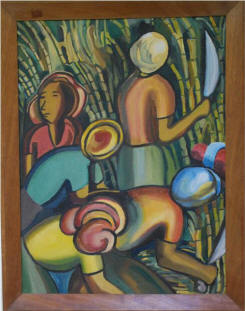
Roger
Mais "Cane Cutters"
“Men of ideas outlive their times
An idea held by such a man does not end with his death
His life bleeding away goes down
Into the earth, and they grow like seed
The idea that is not lost with the waste of a single life
Like seed springing up a multitude”
1.0 Summary (max 200 words)
OVERVIEW
Roger Mais (1905-1955) has been recognised as one of
the first postcolonial literary figures to emerge in the former British
Empire. His legacy lies in the large quantity of unpublished material
left after his untimely death.
He is the quintessential anti-colonial activist whose
contribution included literary, political, artistic and journalistic
output. His collection covers over 20 years of activism and serves as a
chronicle of the birth and development of the anti-colonial, nationalist
struggles of the colonised against the coloniser which led to political
independence, the creation of a literary tradition and the birth of an
artistic movement.
Mais has been described as “a
colonial writer grappling with his art, without the benefit of a literary
tradition of his own” (Morris 1981).
His activism was manifested through his literary and
journalistic writing. His imprisonment for seditious libel in 1944 as a
result of his piece, “Now we Know” transformed him into a hero of the
anti-colonial struggle in Jamaica.
Mais published just
three novels, all of which are considered classics of Caribbean
literature. The bulk of his unpublished material has been preserved in
the Roger Mais Collection at the University of the West Indies Library
Mona. This Collection perpetuates the true legacy of Roger Mais as it is
through his published and unpublished material, and his correspondence
that prospective researchers are able to access his philosophy and
political agenda. It is through the material lodged in the Collection
that his development as a writer can be assessed.
The collection’s
significance lies in its heterogeneity in presenting the development of
a pioneer in postcolonial writing, a member of the vanguard of the
anti-colonial and nationalist struggles, and artist.
Karina Williamson states:
The value and
importance of the Roger Mais Manuscript Collection at the UWI Library at
Mona cannot be overstated. Mais is a major figure not only in Jamaican
and Caribbean literary and political history, but in the whole field of
postcolonial literature in English. His concern with the real lives of
the Jamaican underclass, both urban and rural, had a powerful influence
on younger generations of Caribbean writers, while his imprisonment in
1944 for an article condemning British colonialism made him an iconic
figure in the struggle for independence. He was posthumously awarded the
Order of Jamaica in 1978.
As a literary
archive, the collection is exceptionally varied and rich: it represents
every aspect of Mais’s writing from narrative fiction, plays and poems
to journalism and letters. But it also includes records of his
activities from school onwards, thus illustrating his social and
political life as well as his literary development (2012).
Morris, Daphne. (1981). The
Colonial Writer and his World. Paper presented at the Conference of the
Department of English, UWI Mona.
Williamson, Karina. Personal communication Feb. 2012.
2.0 Nominator
2.1 Name of nominator (person or organization)
Library, The University of the West Indies
(Mona)
2.2 Relationship to the nominated documentary heritage
Owner
2.3 Contact person(s) (to provide information on nomination)
1) Mrs Leona Bobb-Semple
Campus Librarian
2) Mrs Frances Salmon
Head, West Indies and Special Collections
2.4 Contact details
leona.bobbsemple@uwimona.edu.jm
frances.salmon@uwimona.edu.jm
Name
Address
Mrs Leona Bobb-Semple
Main Library, The University of the West Indies
Mona
Kingston 7
Jamaica, West Indies.
Telephone
876 927 0083 Facsimile 876 927 1926
Email main.library@uwimona.edu.jm
2.5 Declaration of authority
I certify that I have the authority to nominate the documentary heritage
described in this document to the International Memory of the World
Register.
Signature
Full name (Please PRINT)
Leona Bobb-Semple
Campus Librarian
The University of the West Indies Mona
Date
3.0
Identity and description of
the documentary heritage
3.1 Name and identification details of
the items being nominated
The Roger Mais Collection
The Roger Mais Collection comprises both published and unpublished
material. It is noted for its juxtaposition of literary and political
writings reflecting Mais’s twin interests. It includes virtually every
literary genre – poetry, short stories, drama, novels, as well as
journalistic pieces and pieces on his theory of fiction; in all, over
300 pieces. The Collection is made up of: 87 short stories, 19 plays, 17
radio plays, 7 novels (3 unpublished), 1 unfinished novel, and 1 folder
with over 50 poems. Many of the typescripts have been annotated and
corrected. In addition 21 handwritten notebooks constituting an
important part of the Collection include drafts and fragments
illustrating the development of his craft; letters to newspaper editors
addressing contemporary social and political events. The Collection also
includes newspaper clippings, mainly of Mais’s articles but including
other pieces of interest to him: holographs in both pen and pencil;
correspondence with overseas publishers, mainly from the United States;
correspondence to his literary agents, and personal letters including
letters to writers like John Hearne. The Collection also includes four
paintings – two of which form part of the original collection. The other
two were acquired by the Library at a later date.
3.2 Catalogue or registration details
See attached
list [Appendix I]
3.3 Visual documentation if appropriate (for
example, photographs, or a DVD of the documentary heritage)
The Collection has been digitized and may be
viewed at:
http://library-contentdm.mona.uwi.edu/cdm4/browse.php?CISOROOT=%2FRMstories.
http://library-contentdm.mona.uwi.edu/cdm4/browse.php?CISOROOT=%2FRMaisPlays
http://library-contentdm.mona.uwi.edu/cdm4/browse.php?CISOROOT=%2FRMPostcards
http://library-contentdm.mona.uwi.edu/cdm4/browse.php?CISOROOT=%2FRMmemorabil
3.4
History/provenance
Roger
Mais worked from his home office in Kingston until his hospitalisation
and subsequent death in 1955. On his death, his sister Mrs Jesse Taylor
took possession of all his papers. She transferred all material to the
University of the West Indies Mona Library in 1966. On acquisition Bill
Carr, lecturer in the Department of English, UWI listed the Collection.
The documents which have been housed in the Rare Book Room of the
Library were curated by Dr Daphne Morris in 1978-1979. She indicated
that the Collection spans Mais’s entire creative period.
3.5
BIBLIOGRAPHY
Dissertations
Morris, Daphne A. Roger Mais :
the evolution of a novelist. Ph.D. University of the West Indies, Mona, 1988.
Syriac-Kalai, Sharon.
Christ in crisis? : the Africanisation of Christianity in Afro-Jamaican literature, 1954-1964.
M.A. Univesity
of the West Indies, St Augustine. 2000.
Books
D'Costa, Jean.The treatment of sexuality in the novels of Roger Mais.
[Mona, Jamaica : s.n., 1974]
--- Roger Mais : The Hills were Joyful Together and Brother man.
London : Longman,
1978.
Griffith, Glyne A. Deconstruction, imperialism and the West Indian novel
Kingston : Press University of the West Indies, c1996.
Hawthorne, Evelyn J.
The writer in transition : Roger Mais and the decolonization
of Caribbean culture. New York : P. Lang, c1989.
Articles
Brathwaite, Kamau. “ Jazz and the
West Indian Novel III.” Bim 12.46(1968): 115-26.
--- “Roger Mais”
Twentieth-Century Caribbean and Black African Writers. Second Series.
Edited by Bernth Lindfors and Reinhard Sanders. Detroit, London: Gale,
1993: 78-81.
--- “The unborn body of the life of fiction. Roger Mais' aesthetics with
special reference to "Black lightning".
Journal of West Indian literature 2. 1(1988): 33-35.
Carr, William I. “Roger Mais: Design from a legend”.
Caribbean Quarterly. 13.1(1967): 3-28.
Creary, Jean. “The
Prophet armed: The novels of Roger Mais.” The islands in between: Essays
on West Indian Literature. Edited by Louis James. London: OUP, 1968:
50-63.
D'Costa, Jean. “Roger Mais's Jamaica : 11 August 1905-15 June 1955.”
Jamaica Journal. 29.3: (2006): 6-13.
Ramchand, Kenneth.
“Literature and society: The case of Roger Mais”
Caribbean Quarterly. 15.4 (1969): 23-30.
Morris, Daphne. Roger
Mais manuscripts in the UWI Library: a portrait of the writer in the
making”. Jamaica Library Association of Jamaica Bulletin. (1979-1980):
36-41.
Williamson, Karina.
“Reinventing Jamaican History: Roger Mais and George William Gordon.”
Beyond the Blood, the Beach & the Banana: new Perspectives in Caribbean
Studies. Edited by Sandra Courtman. Kingston: Ian Randle, 2004: 387-406.
--- “ Roger Mais: West Indian Novelist.”
Journal of Commonwealth Literature, 2, (1967): 138-47.
3.6 Names, qualifications and contact details of up to three
independent people or organizations with expert knowledge about the
values and provenance of the documentary heritage
Name
Qualifications
Contact details
1.Professor Edward Baugh
Professor Emeritus
edwardbaugh@aol.com
The University of the West Indies
Mona
2.Karina
Williamson Honorary
Fellow
kwillia4@staffmail.ed.ac.uk
University of Edinburgh
United Kingdom
3.Professor
Sir Roy Augier Professor
Emeritus
fraugier@hotmail.com
The University of the West Indies
Mona
4.0 LEGAL INFORMATION
4.1 Owner
of the documentary heritage (name and contact details)
Name
Address
University of the West Indies
Mona Kingston 7, Jamaica, West Indies
Telephone
Facsimile
876
927 0083
876 927 1926
Email
main.library@uwimona.edu.jm
4.2
Custodian of the documentary heritage (name and contact details if
different from the owner)
Name
Address
Telephone
Facsimile
Email
4.3 LEGAL
STATUS
The Collection
is owned by the UWI.
The Library’s Preservation
Librarian has primary responsibility for the preservation programme and
inspects the Collection periodically.
4.4
Accessibility
Describe how
the item(s) / collection may be accessed
Access is
allowed to researchers and staff of the University of the West Indies as well as
to researchers from other institutions. Remote access is possible through the
Library’s web page where watermarked, low resolution images may be viewed.
Copying or publication is allowed only with permission from the Estate.
4.5
Copyright status
Describe the
copyright status of the item(s) / collection
Published material is in the
public domain. Ownership of the copyright in unpublished material
remains with the Estate.
5.0
Assessment against the selection criteria
5.1 Authenticity
Mais’s sister
transferred all material found in his office to the University of the
West Indies Mona Library in 1966. On acquisition by the Library, W.I.
Carr, lecturer in the Department of English, UWI listed the Collection.
The documents have been housed in the Rare Book Room of the Library and
were listed and organised by Dr Daphne Morris in 1978-1979.
5.2 World significance
The large quantity of
unpublished material left by Mais’s early death attests to his struggle to
produce a literature in a society in which there was no literary tradition. It
exemplifies the struggle of colonial activists in the period after the First
World War leading to independence in the 1950s and 60s. Mais was involved in all
aspects of this awakening having published three novels which are considered
classics of postcolonial literature, produced paintings which are represented in
the Jamaican national collection and been a pioneering member of the
anti-colonial political vanguard, for which he was honoured posthumously with a
national honour. His conviction for seditious libel, a charge which the colonial
government used to silence its opponents, placed him firmly within the ranks of
the leaders of the anti-colonial struggle.
Although his work
was grounded in the Jamaican reality Mais had
“discovered the technique of localizing without being merely local. He had
learnt that to be truly native is to be truly universal” (Ramchand 1968).
George Lamming,
noted Caribbean author and essayist, has stated that “West
Indian writing, in the most organic sense of literary expression, begins with
people like Roger Mais” (Lamming 1966). Nobel Laureate Derek Walcott lists Mais
as one of the pioneers of West Indian literature in his essay “The Garden Path:
V.S. Naipaul” (1987).Michael Manley, late Jamaican Prime
Minister, in discussing Mais’s contribution to human rights in Jamaica stated
that it was through his dramatization of the conditions of the oppressed that he
was able to add to the awareness of the public (1968). This awareness was to the
condition of the urban poor, most notably the Rastafarians.
Mais was the first Jamaican novelist who
presented the indigenous Rastafarian religious cult in a favourable light. His
novel Brother Man brought to the reading public a positive view of
its followers who had been viewed as outcasts.
Lamming, George. (1966) Tribute
to Tragic Jamaican Roger Mais Supplement June 10.
Manley, Michael. (1968) The
angry egalitarian: Roger Mais and human rights. Lecture at the
Creative Arts Centre UWI February 29. Unpublished manuscript P.J.
Patterson Collection University of the West Indies Mona.
Ramchand, Kenneth. (1966) Black
Lightening. Roger Mais Supplement June 10.
Walcott, Derek. (1987).The Garden
Path: V.S. Naipaul. What the Twilight says: Essays (pp. 121-133)
New York: Farrar, Strauss and Giroux.
5.3
Comparative criteria:
Does
the heritage meet any of the following tests? (It must meet at least one
of them.)
Time
The Collection encapsulates
twenty years (1935-1955) of the nationalist movement in the Caribbean.
It reflects the coming of age of the colonial intellectual in the
British Empire and signals the birth of what today is referred to as
Postcolonial Literature.
The political developments
were mirrored by the beginnings of the movement to create an indigenous
art as well as literary tradition. Mais’s contributions to the
Public Opinion of which he was editor, recorded the political
aspects of the nationalist movement.
The period
covered by the Collection witnessed the birth of the Peoples National
Party of which he was a founding member. It saw the emergence of the
Jamaican art movement, reflected in the paintings in the Collection.
Subject
and theme
The Collection reflects the
development of a pioneering writer of postcolonial literature. Its
homogeneity reflects the evolution of the writer from the initial stage
of mimicking the coloniser to the development of a genre in which the
colonised is the protagonist and the setting is that of the common
people. Brother man is the first novel in which the
nascent Rastafarian religious cult and its adherents appear in a
positive light. In the era in which Mais wrote, the Rastafarian was a
“feared despised and rejected group” (Brathwaite 1974).
Brathwaite,
Kamau. (1974). Introduction. In Roger Mais Brother Man.
London: Heinemann
6.0
Contextual information
6.1 Rarity
This collection is unique and
irreplaceable. It represents all the documents in Roger Mais’s
possession at the time of his death and subsequently donated to the
University of the West Indies by his executor. No other Collection
exists. Copies of a small part of the Collection have been lodged at our
sister campus at St Augustine, Trinidad for consultation by a researcher
at that campus
Integrity
The Collection includes all known material produced by
Roger Mais. It includes manuscripts, letters, annotated typescripts,
photographs, paintings, and memorabilia which were produced by or
belonged to Roger Mais; and represents his thirty years of literary,
artistic and political work during the anti-colonial struggle.
7.0 Consultation with
stakeholders
7.1
Provide details of consultation about this nomination with the stakeholders in
its significance and preservation.
The decision for
nomination was made by the Jamaican Committee of the Memory of the
World, UNESCO National Commission for UNESCO in 2008. The proposal was
submitted to the regional committee and vetted at the Regional Workshop
in July 2009.
8.0
Assessment of risk
Detail the
nature and scope of threats to this documentary heritage.
There are no obvious threats to the Collection at this time. Its storage is
secure from most natural disasters except perhaps earthquake. Digital copies
have been archived.
9.1 Is
there a management plan in existence for this documentary heritage?
YES
The Collection is stored in a
climate controlled room with a modern fire protection system. The
material is stored in acid free envelopes and enclosures. The
Collection has been digitized to prevent constant handling. Digital
masters have also been stored in an electronic vault at the central
computing facility of the University of the West Indies, Mona.o
10.0 Any other information
Detail any
other information that supports the inclusion of this documentary heritage on
the International Memory of the World Register. If the nomination is successful,
how will you use this to promote the MoW Programme?
The Collection has been earmarked to be part of the nucleus of the new Caribbean
Leaders Collection. Other such collections are: the papers of Vic Reid - Mais’s
contemporary; his friend John Hearne; Prime Ministers Seaga and Patterson; poet
Tony Mc Neill. Inscription of the Mais Collection in the International Register
would be the first individual inscription from Jamaica and would be used for
publicity and to encourage other possible donors to come forward with
significant historical and literary material. This would, in turn, provide
promotion of the Memory of the World Register.
APPENDIX -
Annotated Bibliography of Roger Mais Collection in the UWI Library
Updated October 4, 2013
Top
|
Tabula Iamaicae Insulae per Edw. Slaney, 1678
|
|
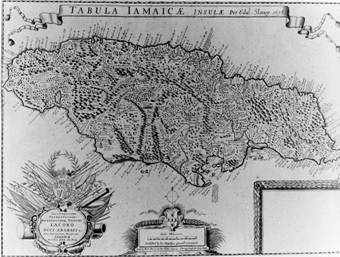
Tabula Iamaicae Insulae per Edw.
Slaney
ABSTRACT
Edward Slaney’s map of Jamaica was published in 1678. Described by Richard Dunn in Sugar and Slaves as the map that best displays the early topography of Jamaica, Slaney’s map is excruciatingly observant to detail and is very useful for persons wishing to study the history of the settlement of Jamaica, land use and tenure, and the spatial distribution of settlements in Jamaica. In addition, for persons wishing to examine the evolution of Jamaica’s geography and geology over time, Slaney’s map is especially helpful. Slaney’s map displays plantations, estates, mountains, rivers and savannas.
PART A – ESSENTIAL INFORMATION
IDENTITY AND LOCATION
Name of Documentary Heritage: Tabula Iamaicae Insulae per Edw. Slaney, 1678
Country: Jamaica
State, Province or Region: West Indies
Address: The National Library of Jamaica, 12 East Street, Kingston
LEGAL INFORMATION
Owner (Name and contact details): The National Library of Jamaica
12 East Street
Kingston
Tel: (876) 967-1526, 967-2516
Fax: (876) 922-5567
Email: nlj@infochan.com
Custodian: As above
Legal Status: Public
Details of Legal and Administrative provisions for the preservation of the documentary heritage: Responsibility for the care, preservation and use of Edward Slaney’s Map of Jamaica lies with the Special Collections and Conservation Dept. of the National Library where it forms part of the Manuscript Collection.
Accessibility: The Edward Slaney’s Map of Jamaica is available to members of the public for consultation, in particular, researchers and academics.
Copyright Status: Copyright-free
Responsible Administration: Edward Slaney’s Map of Jamaica is located at the Special Collections and Conservation Dept. of the National Library of Jamaica and responsible administration for the collection lies with the Executive Director of the National Library.
IDENTIFICATION
Description and inventory:
Edward Slaney’s Map of Jamaica is very detailed and well preserved, considering its age. On the bottom left hand side, there is a coat of arms; the scale, compass etc are in the bottom middle. In a banner above the map is the title of Slaney’s Map “Tabula Iamaicae Insulae per Edw. Slaney, 1678”. Slaney’s Map is one of the earliest and most comprehensive maps of Jamaica. It demonstrates the mountains, woods, estates, cliffs, coastlines and settlements of Jamaica. The map is surprisingly accurate, considering it was drawn over 300 years ago and only 23 years after the settlement of Jamaica. According to Richard Dunn, “Slaney shows the many rivers, particularly numerous along the north coast where rainfall is heaviest…Slaney also shows the mountain ranges crisscrossing the island…There is also a great deal of flat land in Jamaica, marked as savannas on Slaney’s map.”
Bibliographic details:
The Bibliographic details of Slaney’s Map of Jamaica is provided on site in the card catalogue at the Special Collection and Conservations Dept. of the National Library. Likewise, its details are being placed in a database that can be accessed at the National Library. In time, this database will be put online, where it will become easily accessible to persons unable to visit the National Library.
Visual Documentation: A miniature copy of Slaney’s Map of Jamaica is displayed in Richard Dunn’s Sugar and Slaves.
HISTORY
Edward Slaney’s Map of Jamaica was published in London in 1678.
MANAGEMENT PLAN
Bibliographic: Bibliographic details of Slaney’s Map of Jamaica are available in the card catalogue, which is on site at the National Library’s Special Collection and Conservations Dept. In addition, efforts are being made to place these details in a database, which will eventually become available to persons online who are unable to visit the National Library.
Preservation Plan: Edward Slaney’s Map of Jamaica is overall very well preserved. Patrons are advised to use gloves when consulting this manuscript. In addition, the map is stored in an acid free folder. The map will be digitized at a later date.
ASSESSMENT AGAINST THE SELECTION CRITERIA
Influence
Slaney’s Map of Jamaica has had a great influence on the history of Jamaica. Richard Dunn, author of Sugar and Slaves notes that Slaney’s map is the best map that depicts the early topography of Jamaica. Slaney’s map has been used by historians seeking to reconstruct the spatial distribution of the early white settlers. One notable observation made from the map is that many of the settlements were mostly located along the coast. However, in the south, there is clear evidence that the white settlers were moving inwards. In contrast, in the western portion of Jamaica, the settlements were along the coast. Slaney noted rivers, mountains etc and as such persons studying the evolution of Jamaica’s topography would find this map useful because it is so detailed.
Time and Place
Slaney’s map was drawn in 1678 and as such it is only 23 years after the conquest of Jamaica by the English in 1655. As such, Slaney’s map gives an idea of the settlement patterns of these early settlers and the changes that have been made since then. It also displays the fact that these men must have explored their new territory. In essence, Slaney’s map shows how developed Jamaica was after her conquest.
People
Though there were some Africans among the early settlers, for the most part these persons were Europeans. A study of the map drawn by Slaney therefore is in essence the study of these persons.
Subject/Theme
Slaney’s Map of Jamaica is useful for persons studying the economic and social history of Jamaica. Likewise persons interested in geography and geology will find this map useful.
Form/Style
The map is consistent with 17th century style. However, Slaney’s map is extremely detailed for the time, including mountain ridges, rivers and settlements. As such persons interested in early map-making and drawing should consult Slaney’s map.
Social Value
Edward Slaney’s Map of Jamaica possesses tremendous social value. Dunn notes that it is one of the best maps to consult for the early topography of Jamaica because it is so detailed.
Integrity
Edward Slaney’s Map of Jamaica is in very good order. However, though all sites and areas of Jamaica are represented, some are unnamed.
Rarity
A copy of Slaney’s Map is held by the John Carter Brown Library at Brown University in Providence. This is where Dunn obtained the copy of the map he used in his text. However, the copy in the National Library is that owned by Jamaica and is important for citizens and scholars wishing to examine it.
CONSULTATION
Dr. James C. Robertson
Department of History and Archaeology
University of the West Indies, Mona
Jamaica.
NOMINATOR
National Library of Jamaica
PART B
ASSESSMENT OF RISK AND PRESERVATION ASSESSMENT
Edward Slaney’s Map of Jamaica, 1678 is well preserved considering its age. Acid free folders have reduced corrosion. Some repair however has been made as the original paper has been glued with special glue unto rice paper. The map itself is in good order.
Top
|
The
Walter Adolphe Roberts Collection
|
|

Walter Adolphe Roberts
ABSTRACT
The Walter Adolphe Roberts Collection appears to have been one that was formed by the namesake of the collection from his adolescence until his death in 1962. The Collection is mainly comprised of family documents, correspondence, photographs, scrapbooks (newspaper clippings, etc.), lectures, broadcasts, articles and book reviews, literary manuscripts, papers and documents concerning various organizations with which W. A. Roberts was connected and miscellaneous historical documents and papers which may have belonged originally to contemporary writers and historians closely associated with him. Persons interested in studying and researching Jamaica’s intellectual and literary history and developments in the late 19th and early 20th centuries will find the Collection especially useful, as Roberts was in touch with and formed part of the budding intelligentsia of Jamaica.
PART A – ESSENTIAL INFORMATION
IDENTITY AND LOCATION
Name of Documentary Heritage: The Walter Adolphe Roberts Collection
Country: Jamaica
State, Province or Region: The Caribbean
Address: The National Library of Jamaica, 12 East Street, Kingston
LEGAL INFORMATION
Owner (Name and contact details): The National Library
12 East Street
Kingston
Tel: (876) 967-1526, 967-2516
Fax: (876) 922-5567
Email: nlj@infochan.com
Custodian: As above
Legal Status: Public
Details of Legal and Administrative provisions for the preservation of the documentary heritage: Responsibility for the care, preservation and use of the Walter Adolphe Roberts Collection lies with the Special Collections and Conservation Dept. of the National Library where it forms part of the Manuscript Collection.
Accessibility: The W. A. Roberts Collection is available to members of the public for consultation, in particular, researchers and academics.
Copyright Status: The collection was handed over as a gift to the Institute of Jamaica;the collection is not covered by copyright.
Responsible Administration: The W. A. Roberts Collection is located at the Special Collections and Conservation Dept. of the National Library ofJamaica and responsible administration for the collection lies with the Executive Director of the National Library .
IDENTIFICATION
Description and inventory: The Walter Adolphe Roberts Collection consists of 25 document boxes containing family papers, correspondence, newspaper clippings, lectures, broadcasts, photographs, articles, book reviews, literary manuscripts, papers and documents concerning various Jamaican organisations and miscellaneous historical documents and papers, belonging to various contemporary writers and historians associated with W. A. Roberts.
The collection consists of books, magazines, periodicals, prints, photographs which are being organized and with items being placed in acid free folders.
W. A. Roberts’ social circle was very wide and as such his correspondence was extensive. He wrote to and received letters from persons including Clara Maude Garret and Lily Garrett, Edna and Norman Manley and W. A. Domingo. Though some letters were hand written, the majority were typed. Besides letters, the correspondence also includes a sizeable collection of postcards as well. These postcards are stored with the photograph collection and main subjects include miscellaneous paintings, Spanish National costumes, Versailles, Natural History, Havana, British Museum, Rome, Paris and Nice.
The collection also contains many mundane items including payments made to or from Roberts. In addition, bank statements and checks, belonging to Roberts are also included, as are telephone bills.
The Scrapbooks date from c. 1903 to 1961 and broadly covers the artistic, literary, political, journalistic and general interests of W. A. Roberts. Others however, are ordinary hard cover texts. In general, the pages are thick but fragile due to aging and at times the work of insects is clearly discerned. The scrapbooks are comprised of many clippings from newspapers, periodicals and other sources. The subject matters include: Jamaican self government, nature sketches of Jamaica, Simon Bolivar, the French West Indies, West Indian leaders, Jamaica in the Old Days, women (of which Roberts seemed to have an aesthetic fascination) and Puerto Rico.
The Collection contains photographs which are properly labelled by subjects and all related ones are placed in acid free folders. Many of the photographs are centred on Roberts, either of himself, or places where he resided; pictures that were to go in his autobiography or pictures of his friends and family.
Bibliographic details: The bibliographic details of the Walter Adolphe Roberts Collection are on site on card catalogue at the Special Collections and Conservation Dept. of the National Library. It is filed under MS. 353.
Visual Documentation: The National Library has a bust of W. A. Roberts on display.
HISTORY
The Walter Adolphe Roberts Collection was presented to the library shortly after his death.
MANAGEMENT PLAN
Bibliographic: Steps are being taken to place the details of the Walter Adolphe Roberts Collection on a database that will eventually allow for online access for persons not able to visit the National Library. Furthermore, ongoing work is being done to the collection itself to sort, list and label the boxes and the contents.
Preservation Plan: The work on this collection is in progress.
ASSESSMENT AGAINST THE SELECTION CRITERIA
Influence
The Collection concerns a man who had a great influence on Jamaican development, both historically and culturally. He was also a great literary figure in Jamaica’s history. From the above one can see that his circle was as wide as it was influential in the development of Jamaica’s history; Norman and Edna Manley being among his acquaintances as were other members of the later formed People’s National Party, Jamaica’s current ruling political party. Walter Adolphe Roberts was born in Kingston, Jamaica, on the 15th October, 1886. He was a journalist, poet, novelist, historian and political thinker. Roberts was privately educated at home, largely by his father who had been a silk merchant in China before coming to Jamaica. In 1902, Roberts became a reporter on the staff of the Daily Gleaner. Later he was war correspondent for the Brooklyn Daily Herald from 1914 to 1917, and after that edited several American periodicals. He founded a branch of the Jamaica Progressive League in New York in 1936 and another of the League of Jamaica until 1949, when he soon became prominent in cultural activities. He quickly became editor of the Pioneer Press and President of the Jamaica Historical Society. The range of his publications was wide, ranging from poetry and novels to history and biography. W. A. Roberts was a nationalist who believed that Jamaica was more than a mere petty British colony. He predicted that the country would play a very important role in the future and that her past was glorious. Roberts passed away in 1962.
Time
The Walter Adolphe Roberts Collection spans the generation before him, containing family papers of his grandparents, parents and other relatives and friends. As such, persons interested in the study of Jamaica in the 19th and early to mid-20th centuries will find this collection useful. Roberts was a part of the budding Jamaican intelligentsia and as such he was involved in organisations that steered Jamaica’s development e.g. the Jamaica Progressive League. He knew the founder of the People’s National Party, Norman Manley. Additionally, the Collection spans the period of the search for a Jamaican common identity, the era of decolonisation and federation. This was a ripe time for many political thinkers to be right on the scene and that Roberts and his friends certainly were.
Place
The Walter Adolphe Roberts Collection covers documents from Jamaica, Europe and Latin America. This is due to the fact that Roberts’ circle of acquaintances spanned several continents. In addition, he was once described as a man with cosmopolitan tastes and interestingly, Roberts was greatly influenced by Latin America and France.
People
The Walter Adolphe Roberts Collection contains correspondences with persons such as Clara Maude Garret and Lily Garrett, Frank Cundall Edna and Norman Manley and W. A. Domingo. The three latter were influential in Jamaica’s politics and economy. In addition, Roberts was in touch with many other influential and international historical and political thinkers such as J. L. Ragatz and Eric Williams. Thus the W. A. Roberts Collection provides an additional source for the study of these persons.
Subject/Theme
Politics and academia are recurring themes of the collection. The historical progress of Jamaica can also be studied as also the West Indies Federation, the World Wars, Jamaica’s public and political affairs.
Form/Style
The manuscripts of Roberts’ works are worth examining especially since his style fused Latin American and French influences. Likewise, his work in prose and poetry are also interesting.
Social Value
From the above discussion, it is clear that the Walter Adolphe Roberts Collection is of social value. Roberts played an important role in the development of Jamaica’s academic community. His acquaintances with whom he often communicated were influential in the Jamaican society and political landscape.
Integrity: The Collection is fairly complete and though part of the collection has been sorted and preserved in acid free boxes, the rest is yet to be done.
Rarity
These manuscripts are single and rare. No copies exist elsewhere of the Walter Adolphe Roberts Collection.
CONSULTATION
The National Library
12 East Street
Kingston
Tel: (876) 967-1526, 967-2516
Fax: (876) 922-5567
Email: nlj@infochan.com
NOMINATOR
James Robertson
Dept. of History and Archaeology
University of the West Indies
Mona
Kingston 7
PART B
ASSESSMENT OF RISK AND PRESERVATION ASSESSMENT
The Walter Aldophe Roberts Collection is in fairly good order, being sorted and preserved in acid free folders. Nevertheless, due to aging, some of the material is rather brittle and fragile and as such, it would be recommended that this material within a few years be digitised to preserve it for posterity. The map of the City of Kingston, located in the photograph collection needs to be restored because though in acid free folder, it has torn along the creases where it was originally folded.
Top
|
Worthy Park Estate Collection
|
ABSTRACT
The Worthy Park Estate Collection contains over 150 documents including plantation books, estate journals, accounts, letter books produced from a premier sugar estate which still exists in Jamaica today. Its rich, over 200 year history is reflected from this collection, which dates from as far back as 1783. This collection has been used by myriad historians of the region because of its detailed records, which constitute a historical account of not only this plantation and its surrounding area, but enlightens today’s historian about the general history of that time with regard to the rewards, pitfalls, and challenges of plantation management in the Caribbean.
IDENTITY AND LOCATION
Name of documentary heritage: Worth Park Estate Collection
Country: Jamaica
State, Province or Region: Caribbean
Address (location of doc): Jamaica Archives, Corner of King and Manchester Streets, Spanish Town.
Legal Information
Owner: Worthy Park Estate/Jamaica Archives
Custodian: The National Archivist
Legal Status: This is a privately owned collection that is accessible to the public, to be used at the National Archives. There are no restrictions on its use within the purview of proper treatment of the documents.
Details of legal and administrative provision for the preservation of the Documentary heritage:
Accessibility: The Collection at the Archives is available for research by historians and other researchers. Patrons of the archives are required to sign books explaining the purpose of research and contact details. There are no other requirements for use of this particular collection. Like all other Archival holdings, it cannot be removed from the Clinton Black Reading Room, the central reading room in the Jamaica Archives. One volume of the collection is noted by Kenneth Ingram as being separated from the collection and is now in the Library of Congress and includes 14 coloured manuscript plans of Worthy Park estate and adjoining lands, 1715-1834, and can also be found in the PRO, London (map collection MPGG 56).
Copyright Status: The age of many of the documents in this collection makes them difficult to reproduce by photocopying, but digitizing under the supervision of archive staff of a selected amount, as well as note taking, is permitted. However, credit must be given to the Archives and the exact references provided each time the information is reproduced.
Responsible administration: Responsibility for the collection is with the Government Archivist.
Identification
Description: The index for the worthy park records include a detailed breakdown of the collection and include
Plantation books: Worthy Park plantation books: 1783-1845, Mickleton Plantation Books, 1836-7, Thetford Plantation Book 1798-1808, Worthy Park Wage Records 1846-1970, Worthy Park Management Records, 1846-1970,Worthy Park Financial Statements, 1926-70, Statistical Data from research Dept, Meteorological reports, Miscellaneous deeds and map fragments, Fred Clark’s Diaries 1915-32
Production Books: Worthy Park Production Book 1791, Cane Book 1935, Gang Weight Book 1946-47
Stock: Worthy Park Still House Book 1886-93, Stores Book1930-31 and 34-35, Tool Book: 1932-34
Accounts: pay bills Worthy Park 1842-1944 (84 volumes in all)
Swansea Estate: (30) 1893-1928
Accounts: General Worthy Park Wages 1839, Abstracts of wages 1864-78, Expenses abstract 1884-95, Expenses, accounts and production 1875-77, Rent accounts 1869-77, Rent book 1901-05, (Thetford and Swansea included- adjoining estates which ever eventually incorporated into Worthy Park in 1874 and1881and respectively), Account book including Talbot’s notes 1876-82, Cash book 1898-1906, Expenditure, and receipts book 1932-34, Thetford: workmen’s day book 1839-40, Albion estate: abstract of wages 1923-24.
Bibliographic Details: Kenneth Ingram’s “Sources of Jamaican History” makes reference to the Worthy Park collections, and many historians who have worked on slavery in Jamaica make reference to its contents. In particular however, the ground breaking book “A Jamaican Plantation The history of Worthy Park 1670-1970” by Michael Craton and James Walvin (London and New York: W H Allen 1970) has specifically utilized the Worthy Park collections among other documents to reconstruct the history of the estate and its significance to Jamaica and the study of slavery in general.
HISTORY
The Worthy Park collection was donated in the 1960s, and has been open to public use since that time.
ASSESSMENT AGAINST THE SELECTION CRITERIA
Influence: The mandate left by the original owners of the estate to preserve its plantation records was continued by subsequent proprietors, and or managers of the estate, where some if not all of the estates records are still preserved. The records include details about tools given out and returned to the estate, description of the tools, to whom given, date taken and date returned, ledgers of the crop production, number of hogsheads of sugar, market rate for the crop, weight of the sugar, who it was sold to and date when it was sold. It also includes the increase and decrease of enslaved people even for periods before slave registration was mandatory (i.e. pre 1817). It gives the name of these people as well as their sex and occasionally their kin. It has information to do with whites employed on the estate, when employed, when discharged salaries and job description and vestry accounts including: enslaved people, whites, runaways. It illuminates the very foundation of West Indian slave societies and gives good insight into the effect of emancipation on sugar estates and production.
Time
The documents span a time of 1783 to 1970. The estate itself though, began operations from the 1600s and still exists today, in the 21st century.
Place
Worthy Park is in the parish of St Catherine in the vicinity of Ewarton in Jamaica: it is a lush green area surrounded by blue-green mountains. This is the vale of Lluidas, which is dominated by the estate of Worthy Park. The estate grew over time when Lord Shrewsbury’s purchased nearby Swansea in 1874. Then in 1881, the vale’s most vigorous hilly estate, Thetford, was purchased from the government and incorporated into Worthy Park.
People
This vale was first taken by the first English settlers in 1670, but was first populated by Juan De Bolas and his band of Spanish maroons. It was patented by Francis Price and was named by him. He was believed to be an officer in the regiment of Colonel Anthony Buller. It changed hands over time, and was associated with families like the Talbots, Calders and the Clarkes. The estate also grew over time when Lord Shrewsbury’s purchased nearby Swansea in 1874.
Social Value
The value of these records is unmistakable as they are of historical interest or for the edification of historians and researchers as functional records of their time. These historical records give pertinent information about plantation life, business connections and transactions of a typical sugar plantation. It gives just as much insight into the tasks of the managers and proprietors of the estate as the enslaved people who were the backbone of its profitability.
Integrity
The documents are original records. They are stored together at the archives, apart from the map collection at the PRO, London. They reflect the writing style, and record keeping of the time they were produced. Though they are separate documents, there is continuity in terms of date, and topics.
Rarity
There is an increased consciousness of the need for preserving the records of the past with regard to Jamaica’s early history. The poor storage of these records during slavery, as well as the ravages of time have meant that very few plantation records have been preserved to this day in any useable form. In many cases these records are missing, disjointed, water-stained, the writing is faded and the papers have rot. Worthy Park is among a small number of plantation records that have been deposited in their holistic and original form. Price, manager of Worthy Park in the late 18th century, specifically gave directions for the estate’s records to be kept seeing that the “books of the estates are the only Records by which future generations can inform themselves of the management of Plantations”.
MANAGEMENT PLAN
Bibliographic: The records have been well utilized and therefore ‘preserved’ in Craton and Walvin’s book. In terms of the Jamaica Archives the collection is well indexed in their private index, and some aspects of the work have been microfilmed, particularly the very old records.
Preservation Plan: The archive takes special precautions to safeguard the quality of its collections, by instructing patrons in the proper techniques when using the documents. Patrons are not allowed to use pens in the reading room, and are sometimes offered magnifying glasses if the material is hard to decipher. Proper handling of these records is stressed. The archive has embarked on a 5 year plan to microfilm all its collections, particularly older ones and those that are deteriorating with time. However the completion of this is contingent on funding.
CONSULTATION
John Aarons
53-56 Church street
Kingston
Tel: (876) 922 3705-6
NOMINATOR
Jamaica Archives
Top
|
Worthy Park Estate - Plan of Cane Fields
|
ABSTRACT
The Worthy Park Estate - Plan of Cane Fields contains over 150 documents including plantation books, estate journals, accounts, letter books produced from a premier sugar estate which still exists in Jamaica today. This particular plan however is one of the only plans of the estate that remain in Jamaica. While 14 coloured manuscript plans of Worthy Park estate and adjoining lands, 1715-1834, and can also be found in the PRO, London (map collection MPGG 56), this plan is unique in its location as well as its contents.
IDENTITY AND LOCATION
Name of documentary heritage: Worthy Park Estate - Plan of Cane Fields
Country: Jamaica
State, Province or Region: West Indies
Address (location of doc): Jamaica Archives, Corner of King and Manchester Streets, Spanish
Town
Legal Information
Owner: The official owner is the Worthy Park Estate but the Jamaica Archives has similar rights when storage and use of the materials are concerned.
Custodian: The National Archives.
Legal Status: Privately owned collection, including the plan of the estate, is accessible to the public, to be used at the National Archives. There are no restrictions on its use within the purview of proper treatment of the map.
Details of legal and administrative provision for the preservation of the Documentary heritage:
Accessibility: The Collection at the Archives is available for research by Historians and other researchers. Patrons of the archives are required to sign books explaining the purpose of research and contact details. There are no other requirements for use of this particular plan of the estate. Like all other Archival holdings, it cannot be removed from the Clinton Black Reading Room, the central reading room in the Jamaica Archives.
Copyright Status: The size of the plan is not conducive to photocopying, but digitizing under the supervision of archive staff is allowed. Patrons are also free to take notes. The Archives requires that credit be given to them and the exact reference of the documents be provided each time the information is reproduced.
Responsible administration: Responsibility for the collection is with the government archivist.
Identification
Description: The Plan of the Worthy Park cane fields is a large topographical map work, which was traced from 1942 aerial photograph (reference: J-18-4-426). It was revised when traced in August 1960. The scale is approximately 70 feet per inch. This detailed aerial plan shows roads and intervals, wire fences (boundaries) gullies, drains, the location of factories and other infrastructural aspects of this premier sugar plantation. It also shows sugar cane, citrus and other crops as they are located on the estate.
Bibliographic Details: Kenneth Ingram’s “Sources of Jamaican History” makes reference to the Worthy Park collections, and many historians who have worked on slavery in Jamaica make reference to its contents. In particular however, the ground breaking book “A Jamaican Plantation The history of Worthy Park 1670-1970” by Michael Craton and James Walvin (London and New York: W H Allen 1970) has specifically utilized the worthy park collections among other documents to reconstruct the history of the estate and its significance to Jamaica and the study of slavery in general. In addition, Barry Higman’s “Jamaica Surveyed” makes specific mention of the Worthy Park Plans, and has a very good description of one of the first plans of the estate.
HISTORY
The plan and other contents in the Worthy Park collection were deposited in the National Archives in the 1960s, and have been open to public use since that time.
ASSESSMENT AGAINST THE SELECTION CRITERIA
Influence
The growth of absentee planters during the 18th century led to a group of wealthy proprietors who resided outside of the Caribbean. These were anxious to have visual representations of their estates in the Caribbean territories. This led to the upsurge of many plans being drawn up in Jamaica in particular to show physical representations of the plantations in the island during the slavery era. The post emancipation era also provided another good opportunity for land surveying. These would often show the changes in settlement patterns and the re organization of land in the context of a ‘free society’. The Worthy Park Plan was one such plan that originated in this manner.
Time
The documents span a time of 1783 to 1970. The estate itself though, began operations from the 1600s and still exists today, in the 21st century. This plan itself was last done in 1960.
Place
Worthy Park is in St Catherine in the vicinity of Ewarton in Jamaica: it is a lush green area surrounded by blue-green mountains. This is the vale of Lluidas, which is dominated by the estate of Worthy Park. The estate grew over time when Lord Shrewsbury’s purchased nearby Swansea in 1874. Then in 1881, the vale’s most vigorous hilly estate, Thetford, was purchased from the government and incorporated into Worthy Park.
People
The decline in profits from the Worth Park estates in the 1700s spurred the absentee owner John Price to send his son Rose to Jamaica to ensure proper management of the estate. He arrived in 1791and employed the services of Robert Kirkwood and David Low, both surveyors to produce a plan of the estates.
Social Value
Plans portray the internal layout of large agricultural units. In this case the worthy park estate’s internal organization is well portrayed in this large topographical plan. It shows the boundaries of properties and is useful for the analysis of land tenurship and settlement patters on this estate in particular and gives an indication as to how plantations are structured for maximum returns in terms of the physical layout and as such visual plans of estates give a fuller picture of plantation life. While some may choose to use plan like these for decorative purposes, others interested in cartography of the period as well as plantation history will find it useful for studying plan making, and general patterns of spatial distribution and land use on sugar estates. Others may find it useful for studies in soil type and for tracking the potential of each field by the crop that was planted there.
Integrity
The documents are original records. They are stored together at the archives, apart from the map collection at the PRO, London. This plan is not the original plan produced in the 1700s under the request of Rose Price. However it is an authentic and certified plan of the estate.
Rarity: Barry Higman noted Historian, informs us that surviving plans depicting the internal layout of plantations for Jamaica are greater in number than for any other Caribbean territory. However this plan in itself is rare as it is one of the few surviving plans of the Worthy Park estate that remain in Jamaica.
MANAGEMENT PLAN
Preservation Plan: The archive takes special precautions to safeguard the quality of its collections, by instructing patrons in the proper techniques when using the documents. Patrons are not allowed to use pens in the reading room, and are sometimes offered magnifying glasses if the material is hard to decipher. Proper handling of these records are stressed The archive has embarked on a 5 year plan to microfilm all its collections, particularly older ones and those that are deteriorating with time. However the completion of this is contingent on funding.
CONSULTATION
John Aarons
53-56 Church street
Kingston
Tel: (876) 922 3705-6
NOMINATOR
Jamaica Archives
|
|
Top | Home
| Collection
|